
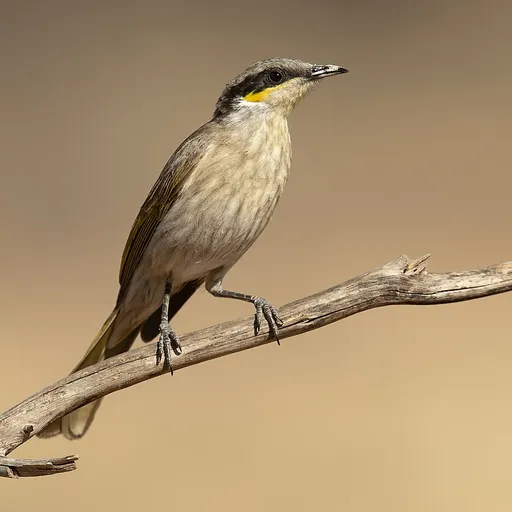
Singing Honeyeater
Gavicalis virescens
Least Concern
Overview
The singing honeyeater is a small bird found in Australia, belonging to the honeyeater family Meliphagidae. It is a relatively common species with a Least Concern conservation status on the IUCN Red List.
Identification
- Length ranges from 17–22 cm with an overall grey-brown appearance.
- Wings and tail are olive-green with flashes of yellow.
- Features a broad black stripe from behind the beak to the back, and a yellow streak immediately below this from the eye.
- Song varies from scratchy to melodious and changes depending on location.
Habitat
The species inhabits a wide range of shrubland, woodland, and coastal habitats. It is widespread across Australia west of the Great Dividing Range, extending to the west coast and Western Australian coastal islands, but does not occur in other countries.
Diet
These omnivorous birds consume nectar, small insects, fruits, grubs, and berries. They are also opportunistic nest predators of smaller birds, such as the zebra finch, taking advantage of nests left unattended.
Did you know?
Singing honeyeaters lack the ability to communicate with isolated birds of the same species; mainland birds did not respond to the songs of individuals on Rottnest Island, which feature shorter melodies with fewer syllables and notes.
Sources
- Wikipedia · CC BY-SA 4.0
- Wikidata · CC0 1.0