
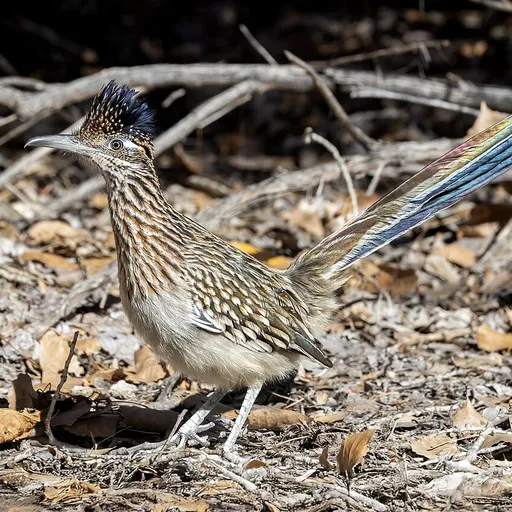
Greater Roadrunner
Geococcyx californianus
Least Concern
Overview
The greater roadrunner (Geococcyx californianus) is a long-legged, ground-dwelling bird in the cuckoo family, native to the arid regions of the Southwestern United States and Mexico. Also known as the chaparral cock or ground cuckoo, it is the largest cuckoo in the Americas and is classified as Least Concern on the IUCN Red List.
Identification
- A 52–62 cm long bird with brown upperparts featuring black streaks and occasional pink spots, contrasting with a white belly and streaked neck.
- Distinctive head markings include an erect brown crest and a bare patch of orange and blue skin behind the eyes, with the blue turning white in adult males.
- Possesses a long, stout, hooked bill that is grayish-brown to gray, and long legs with zygodactyl feet that have brown toes and pale gold spots.
- Vocalisations include a low, descending series of 'cooing' noises by the male, and short, low-frequency shrills resembling coyote squeals by the female.
Habitat
Occupies arid and semiarid scrubland with scattered vegetation typically under 3 m in height, ranging from 61 m below sea level to 2,300 m elevation. Found in the Aridoamerica ecoregion, covering much of the Southwestern US states including California, Texas, New Mexico, and Arizona, as well as northern Mexico, though it is non-migratory.
Diet
This omnivorous species forages on the ground, using its speed to catch prey such as insects, spiders, scorpions, small mammals, lizards, and young rattlesnakes. It also consumes some plants, eggs, and the young of other birds, and has been observed scavenging carrion from larger mammals.
Did you know?
Although capable of limited flight, the greater roadrunner is the fastest-running bird with the ability to fly, reaching speeds of up to 26 mph, and uses its tail as a rudder to change direction while running.
Sources
- Wikipedia · CC BY-SA 4.0
- Wikidata · CC0 1.0