
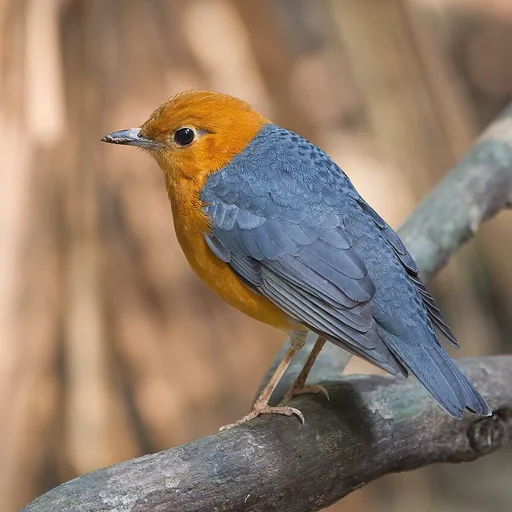
Orange-headed Thrush
Geokichla citrina
Least Concern
Overview
The orange-headed thrush (Geokichla citrina) is a small bird in the thrush family, native to the Indian subcontinent and Southeast Asia. It is a common resident of well-wooded, damp areas, though the species is generally shy and secretive. The population is currently classified as Least Concern by the IUCN Red List.
Identification
- Size: 205–235 mm in length, weighing between 47–60 g.
- Plumage: Males have an entirely orange head and underparts with uniformly grey upperparts and white median and undertail coverts; females are similar but have browner or more olive upperparts.
- Markings: All forms display a strong white band on the underwing, while the cyanota subspecies features a white throat and face with two black stripes running downwards from below the eyes.
- Voice: The song is a loud, clear series of variably sweet lilting musical notes, resembling the common blackbird but with the repetitive structure of a song thrush, often including imitations of other birds.
Habitat
Found in moist broadleaved evergreen woodlands with medium-density undergrowth, bamboo forests, and, in some subspecies, large gardens and orchards. The species prefers shady, damp areas such as those near streams or in shady ravines, occurring between 250 and 1830 metres in the Himalayas and up to 1500 metres in Malaysia, Thailand, and Java. The range spans the Indian subcontinent and Southeast Asia, extending to Java and southern China.
Diet
The orange-headed thrush is omnivorous, consuming a wide range of insects, earthworms, spiders, other invertebrates, and fruit. It forages on the ground in dense undergrowth or thick cover, probing the leaf litter, with feeding activity most prominent at dawn and dusk.
Did you know?
Although the species benefits from forest maturation in places like Hong Kong, its numbers have severely declined in Java due to trapping for the cage-bird trade. It is also host to the pied cuckoo, a brood parasite whose egg may not evict the host's eggs but whose chick outcompetes the host's young for food, often resulting in the death of the host's offspring.
Sources
- Wikipedia · CC BY-SA 4.0
- Wikidata · CC0 1.0