
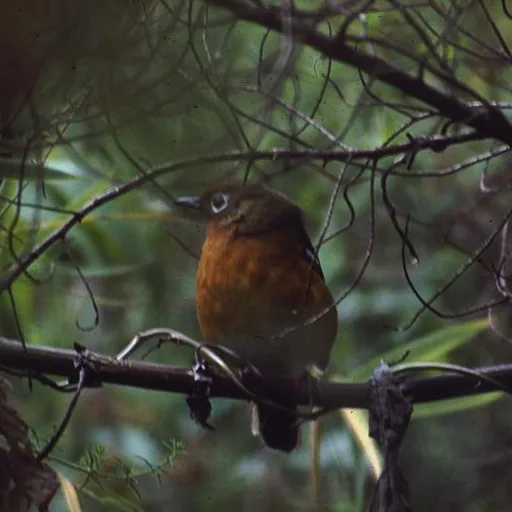
Abyssinian Ground Thrush
Geokichla piaggiae
Least Concern
Overview
The Abyssinian ground thrush is an attractive but rather secretive thrush native to north-east Africa. It inhabits high-altitude montane forests and is classified as Least Concern on the IUCN Red List.
Identification
- Adults feature a deep rufous orange head and face with a distinct white eye-ring, transitioning to less rufous plumage on the breast and flanks.
- Upperparts are olive brown, contrasting with an orange-brown rump and tail, and the folded wing displays two prominent white wingbars.
- Measuring 19–20 cm in length and weighing 43–65 g, immature birds appear paler and duller than adults.
- The contact call is a high-pitched "tseep", while the song consists of a melodious series of whistled phrases rendered as "chee-cheeleeroo-chruup".
Habitat
This species occurs in the undergrowth of evergreen montane forests within high rainfall regions between 1,800 and 3,300 m, mostly above 2,500 m. Its range extends across south-eastern South Sudan, the Boma Plateau, the Ruwenzori Mountains, eastern Democratic Republic of Congo, western Uganda, Rwanda, northern Burundi, central and southern Kenya, and northern Tanzania. It may also be found in bamboo forest and exotic pine plantations.
Diet
The Abyssinian ground thrush forages on the ground by hopping, running, or walking under trees and dense vegetation, searching leaf litter for earthworms, millipedes, snails, and insects. It frequently follows ant swarms to catch fleeing invertebrates and also feeds on fruit such as figs, berries, and seeds in fruiting bushes or trees.
Did you know?
Young Abyssinian ground thrushes remain with their parents for up to three months after fledging. The species' binomial nomenclature honours the 19th-century Italian explorer of East Africa, Carlo Piaggia.
Sources
- Wikipedia · CC BY-SA 4.0
- Wikidata · CC0 1.0