
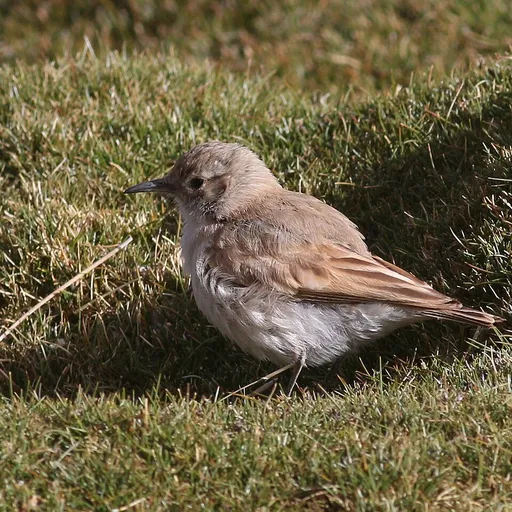
Puna Miner
Geositta punensis
Least Concern
Overview
The puna miner (Geositta punensis) is a medium-sized passerine bird belonging to the ovenbird family Furnariidae. It is classified as a species of Least Concern by the IUCN, with a large range and a presumed stable population.
Identification
- Medium-sized bird measuring 13.5 to 14 cm in length, with pale sandy brown plumage from crown to rump and pale buff-white underparts with a tawny tinge on the flanks.
- Features a pale grayish brown face with a buffy whitish supercilium and a blackish bill with a blue-gray base.
- Tail feathers display pale tawny rufous bases and tips, with dark brownish to blackish middles that become paler on the outer feathers.
- Song consists of a long, shrill series of 'veoo' notes that rise and then descend, often mixed with faster, chattier notes; flight call is a sharp 'pzea' or 'kvee'.
Habitat
Inhabits the Altiplano, a high-elevation plateau in the Andes of southern Peru, western Bolivia, northeastern Chile, and northwestern Argentina. It lives in puna grasslands and barren areas, often on open slopes above brushy ravines, between elevations of 3,050 m and 5,000 m.
Diet
Forages singly or in pairs by gleaning food from the ground and small shrubs while hopping rather than walking. Its diet consists primarily of arthropods and seeds.
Did you know?
The puna miner is monogamous and nests in burrows, usually occupying abandoned or existing dry sandy soil tunnels made by the tuco-tuco, a small rodent.
Sources
- Wikipedia · CC BY-SA 4.0
- Wikidata · CC0 1.0