
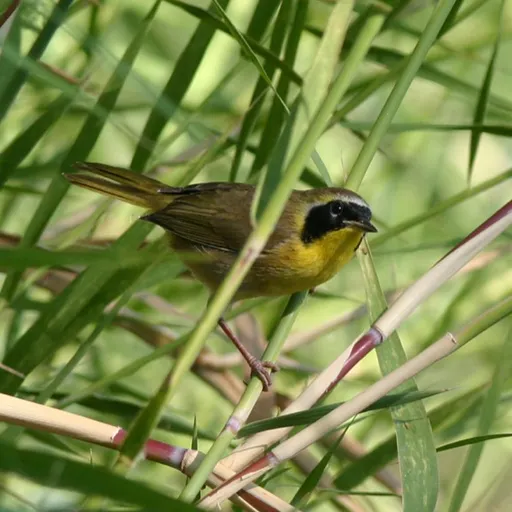
Belding's Yellowthroat
Geothlypis beldingi
Vulnerable
Overview
Belding's yellowthroat (Geothlypis beldingi) is a Vulnerable species of New World warbler that is endemic to Mexico. It is the closest relative of the widespread common yellowthroat and is currently listed on the IUCN Red List as Vulnerable.
Identification
- A small bird approximately 14 cm in length with an olive upper body and bright yellow underparts.
- Adult males of the nominate subspecies feature a large black mask extending from the forehead past the eye to the side of the neck, bordered by a yellow band.
- Females lack the black facial markings, displaying a grayish-brown crown and a yellow-olive face with pale arcs above and below the eyes.
- Both sexes possess dark brown irises, pinkish to pinkish-brown legs, and black bills that may show yellow or grayish tomia in non-breeding seasons.
Habitat
Found exclusively in Baja California Sur, the species primarily inhabits desert oases with freshwater marshes containing cattails and common reeds. It has also been recorded in human-modified sites such as sewage ponds, golf courses, orchards, and mangroves, ranging in elevation from sea level to about 550 m.
Diet
This bird feeds opportunistically on a wide variety of insects, spiders, and other invertebrates without showing a preference for specific prey. It typically forages in pairs during the breeding season and singly at other times, gleaning from marsh vegetation or catching flying insects like damselflies and mosquitoes in mid-air.
Did you know?
The species was named in honour of Lyman Belding, a California naturalist who is credited with discovering it. Its IUCN status has fluctuated significantly, moving from Least Concern in 1988 to Critically Endangered in 2000, before returning to Vulnerable in 2017.
Sources
- Wikipedia · CC BY-SA 4.0
- Wikidata · CC0 1.0