
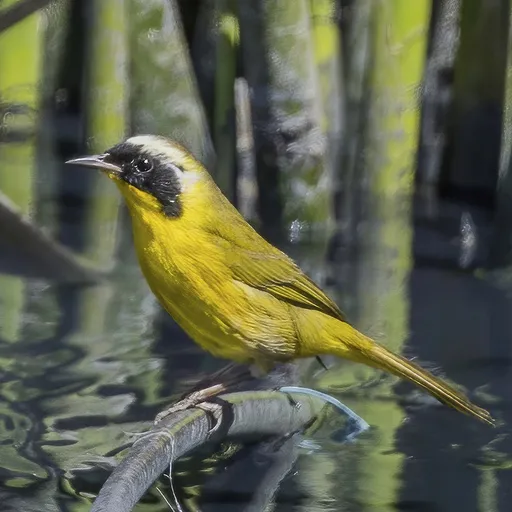
Hooded Yellowthroat
Geothlypis nelsoni
Least Concern
Overview
The hooded yellowthroat (Geothlypis nelsoni) is a species of bird in the family Parulidae, the New World warblers. It is endemic to Mexico and is considered a year-round resident of its range.
Identification
- Approximately 13 cm long, weighing between 10 and 12 g, with sexually dimorphic plumage.
- Males display a wide black mask bordered by a medium gray band, while females lack facial black but possess a pale grayish stripe above the lores.
- Both sexes feature dull olive-green upperparts and yellow underparts, with a dark iris and a black bill that may have a pale mandible in the non-breeding season.
- The song consists of witchy notes ending with upward-inflected sounds, transcribed as "tsjúchohtsjúchot".
Habitat
The species primarily inhabits dry scrublands, brushlands, and chaparral in subtropical and temperate zones, favouring a biome called pedregal characterised by cactus scrub on lava beds. Its range is restricted to Mexico, with the nominate subspecies found in the Sierra Madre Oriental and G. n. karlenae in the central highlands, occurring at elevations generally between 1,250 and 3,100 m.
Diet
The hooded yellowthroat feeds on insects and other invertebrates. It usually forages by gleaning in dense low vegetation.
Did you know?
Although the breeding season is thought to occur from April to July, the nest is a cup made from coarse grass lined with finer grass, typically placed near the ground in a dense clump of grass.
Sources
- Wikipedia · CC BY-SA 4.0
- Wikidata · CC0 1.0