
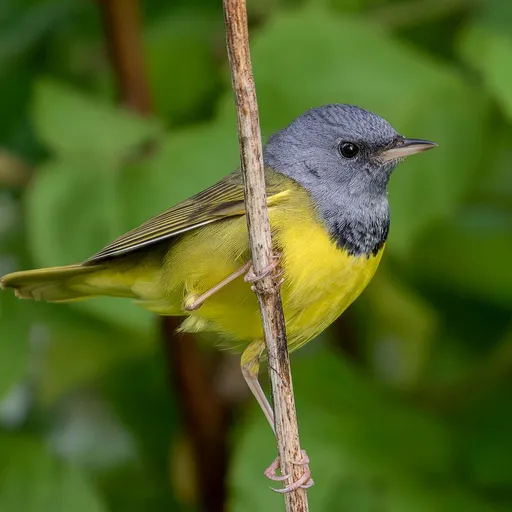
Mourning Warbler
Geothlypis philadelphia
Least Concern
Overview
The mourning warbler (Geothlypis philadelphia) is a small songbird of the New World warbler family that breeds in eastern and central North America and winters in Central and South America. It is a neotropical migrant associated with dense second-growth forests.
Identification
- Yellow underparts and olive-green upperparts, with a thin, pointed bill and pink legs.
- Adult males display a gray hood, black lores, and a distinct black patch on the throat and breast, while females and immatures have gray-brown heads and yellow-gray throats.
- A key field mark is the absence of a broken eye-ring, distinguishing them from similar species like the MacGillivray's or Connecticut warbler.
- Size ranges from 10 to 15 cm in length with an 18 cm wingspan, and the song is a bright, repetitive warble described as 'chirry, chirry, chirry, chorry, chorry.'
Habitat
During the breeding season, this species prefers second-growth clearings characterised by thickets, semi-open areas, dense shrubs, and dead fallen trees. These habitats are often the result of human activities such as logging or agriculture, or natural events like storms and fires. While wintering, they may occupy scrublands, dry woods, coasts, and urban areas.
Diet
Mourning warblers forage low in vegetation, along tree branches, and by catching insects in flight. Their diet primarily consists of insects, spiders, beetles, caterpillars, and larvae, with some plant material consumed during migration or in winter. They are known to remove the legs and wings of insects before consuming them.
Did you know?
The name 'mourning' warbler refers to the male's gray hood, which is thought to resemble a mourning veil.
Sources
- Wikipedia · CC BY-SA 4.0
- Wikidata · CC0 1.0