
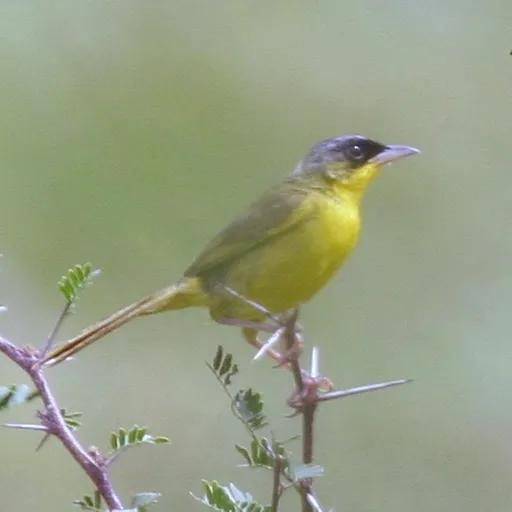
Grey-crowned Yellowthroat
Geothlypis poliocephala
Least Concern
Overview
The grey-crowned yellowthroat (Geothlypis poliocephala) is a species of New World warbler found from Mexico to Panama. It is a year-round resident, though it is occasionally observed as a rare vagrant in Texas. The species is classified as Least Concern by the IUCN Red List.
Identification
- Approximately 14 cm (5.5 in) long with a long graduated tail, a stout bill with a visibly curved culmen, and dark brownish legs.
- Adult males have an olive-gray head with a gray crown, black lores, white eye crescents, grayish olive-brown upperparts, yellow underparts, buff-washed flanks, and yellowish white bellies.
- Females resemble males but have grayish lores, yellowish white eye crescents, and a brownish olive wash on the head; both sexes possess dark irises and blackish bills.
- The song is a long, rich series of varied and jumbled musical phrases, while calls include high-pitched grating notes, descending three-syllable notes, a loud slapping chack, and a chee.
Habitat
The grey-crowned yellowthroat inhabits semi-arid to damp grassy landscapes such as shrubby fields, hedgerows, scrublands, savanna, and sugarcane plantations. It typically occurs at elevations between sea level and 1,500 m, though it can reach 2,000 m locally and 1,750 m in northern Central America. Its range spans from Mexico to Panama, including the Pacific and Caribbean slopes.
Diet
The species feeds on insects and other invertebrates, usually foraging by gleaning in low vegetation, though it sometimes forages on the ground.
Did you know?
The breeding season spans at least from April to July, with clutches containing two eggs in the southern part of the range and up to four further north. The nest is a deep cup made from grass and lined with finer grass and hair, typically placed in dense vegetation near the ground.
Sources
- Wikipedia · CC BY-SA 4.0
- Wikidata · CC0 1.0