
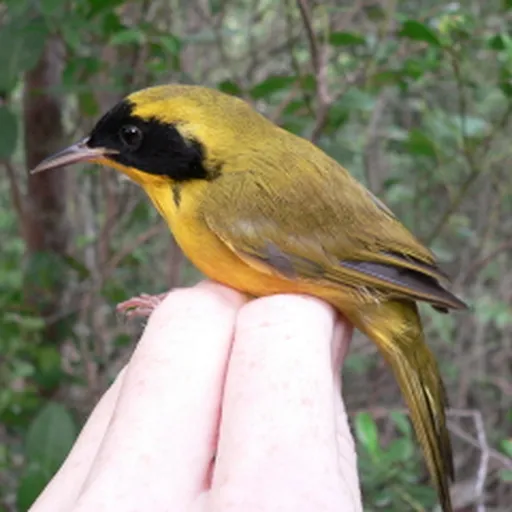
Bahama Yellowthroat
Geothlypis rostrata
Least Concern
Overview
The Bahama yellowthroat (Geothlypis rostrata) is a New World warbler endemic to the Bahamas. It is assessed as a species of Least Concern by the IUCN, though its population is believed to be decreasing due to climate change and brood parasitism.
Identification
- 15 cm long with a rather heavy black bill and dusky pinkish legs.
- Males display a wide black mask around the eye and neck, while females have a plainer face with a brownish crown and thin grayish white supercilium.
- Upperparts are yellowish olive-green, with yellow throats and paler yellow underparts that have an olive wash on the flanks.
- Song is described as a loud, slower, and richer 'wichety wichety wichit' compared to the similar common yellowthroat.
Habitat
Found throughout various islands in the Bahamas, including Andros, Grand Bahama, Abacos, New Providence, Eleuthera, and Cat Island. It primarily inhabits the understory of open pine forest with thick bracken and thatch palm, and occurs in smaller numbers in deciduous woodlands. The species shuns marshes and other wet landscapes.
Diet
Feeds mostly on insects and berries, occasionally consuming small lizards such as anoles. It gleans its food from vegetation.
Did you know?
Since its arrival in the Bahamas in 1994, the brood parasite shiny cowbird has become a significant threat to the species.
Sources
- Wikipedia · CC BY-SA 4.0
- Wikidata · CC0 1.0