
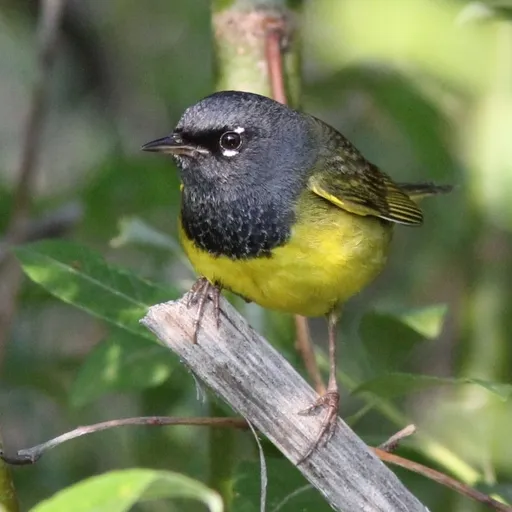
MacGillivray's Warbler
Geothlypis tolmiei
Least Concern
Overview
MacGillivray's warbler (Geothlypis tolmiei) is a species of bird in the family Parulidae, the New World warblers. It is found from southeastern Alaska and western Canada to Panama.
Identification
- Adults are 10 to 15 cm long with a wingspan of 19 cm, featuring a medium gray head and nape that often has a brownish or olive wash.
- Males display dark gray to blackish lores and eyelines, flanked by wide white crescents above and below the eye.
- Underparts include a medium gray throat and upper breast, sometimes with brownish washes, transitioning to yellow lower parts with black mottling on the lower breast in males.
- Both sexes possess a black iris, a dusky brown maxilla, a pale pinkish buff mandible, and legs ranging from brown to burnt umber.
Habitat
The species breeds west of the Cascade Range and Sierra Nevada from southeastern Alaska to Los Angeles, and east of these mountains in the Rocky Mountains. It inhabits forests with dense undergrowth and moderately open canopies, often in regenerating clearcuts, burned areas, and riparian zones. In its winter range, it occurs in mangroves, evergreen forest edges, thorn scrub, and the undergrowth of forests at higher elevations.
Diet
MacGillivray's warbler feeds on a wide variety of larval and adult insects. It takes most of its food by gleaning from leaves on the ground, or from leaves, branches, and bark near the ground.
Did you know?
The species was formally described in 1839 as "Tolmie's Warbler" after William Fraser Tolmie, but Audubon later gave it its current English name to honor William MacGillivray.
Sources
- Wikipedia · CC BY-SA 4.0
- Wikidata · CC0 1.0