
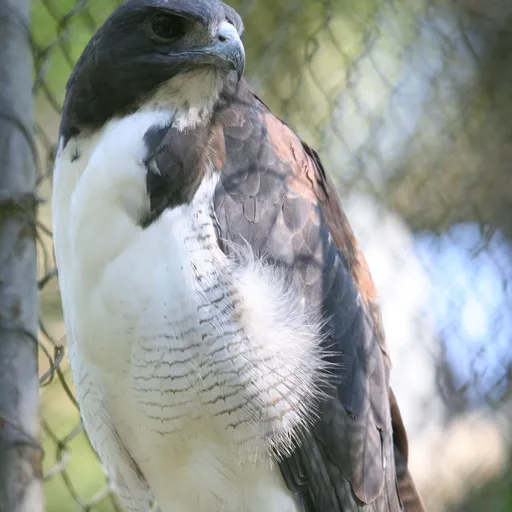
White-tailed Hawk
Geranoaetus albicaudatus
Least Concern
Overview
The white-tailed hawk is a large, stocky bird of prey found in tropical and subtropical environments across the Americas. It is classified as Least Concern on the IUCN Red List and is not considered a globally threatened species.
Identification
- Adults feature grey upperparts and white underparts with faint pale grey or rufous barring, while the short tail is white with a conspicuous narrow black band near the end.
- A distinctive rusty-red shoulder patch is visible when the bird is perched with wings closed, which is absent in younger birds.
- Adults have hazel irises, a pale green cere, and black beaks with a horn-colored base, supported by yellow feet with black talons.
- The call is a high-pitched, tinkling cackle that resembles the bleating of a goat or the cry of a laughing gull.
Habitat
Found from the coast of Texas and the Rio Grande Valley south to central Argentina, including parts of the Caribbean, this species prefers open or semi-open regions with few trees to obstruct flight. It typically inhabits arid environments and avoids areas with heavy rainfall, usually occurring below 600 m elevation.
Diet
This hawk primarily hovers and observes its surroundings to locate prey, with its diet varying by region to include rabbits, lizards, snakes, frogs, arthropods, and small birds. It also feeds on carrion and gathers with other birds at brushfires to catch animals fleeing the flames.
Did you know?
In the open cerrado of Brazil, mixed-species feeding flocks react to white-tailed hawks with almost as much alarm as they do to dedicated bird predators like the aplomado falcon. In the tropics, these hawks rank amongst the main predators of marmosets, small monkeys.
Sources
- Wikipedia · CC BY-SA 4.0
- Wikidata · CC0 1.0