
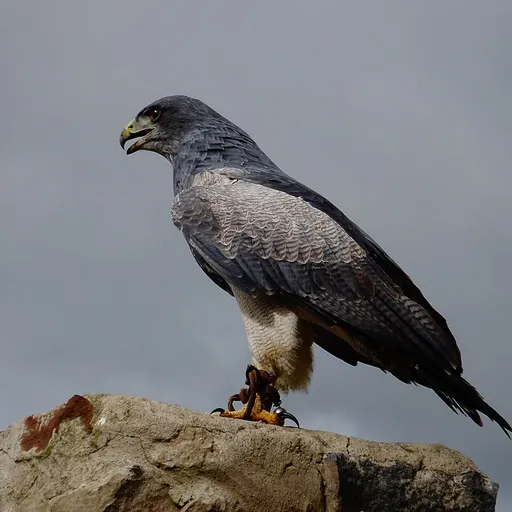
Black-chested Buzzard-Eagle
Geranoaetus melanoleucus
Least Concern
Listen
XC250871 · Niels Krabbe · Imbabura: 12 km N Salinas, near turnoff to La Concepción, Ecuador · CC BY-SA 4.0
Overview
The black-chested buzzard-eagle (Geranoaetus melanoleucus) is a large bird of prey native to open regions of South America, belonging to the hawk and eagle family, Accipitridae. It is the largest extant type of the buteonine lineage and is sometimes referred to by common names such as the black buzzard-eagle or the Chilean blue eagle.
Identification
- A huge, bulky bird with long, broad wings and a short, wedge-shaped tail that is often barely visible when perched.
- Adults feature white underparts, sometimes with fine blackish stripes, contrasting with dark grey upperparts that have a blackish, brownish, or bluish hue.
- From a distance, the wings display a distinct ash-grey and white zone, while the female can be distinguished by a reddish-cinnamon hue on the upper and underwing secondaries.
- The species is generally not very vocal, but in flight it may emit a wild human laugh, a curlew-like whistle, or a high-pitched 'kukukukuku'.
Habitat
This species inhabits mountainous or hilly terrain with sparse vegetation, shrubland, or Nothofagus forest in the southern part of its range. It typically operates between 1,500 m and 4,600 m above sea level, spending significant time soaring in thermals and vertical drafts, and rarely ventures into lowlands.
Diet
Its carnivorous diet consists mainly of mid-sized mammals, including native degus, viscachas, caviid rodents, and the introduced European rabbit. It occasionally preys on birds, large squamates, arthropods, and carrion, positioning it near the top of the avian food chain in its range.
Did you know?
Despite its fierce nature when protecting its offspring, the black-chested buzzard-eagle is considered helpful to farmers by keeping down populations of the European rabbit, which are serious agricultural pests. Additionally, its 'crane' etymological reference stems from its grey upper wings and loud cries.
Sources
- Wikipedia · CC BY-SA 4.0
- Wikidata · CC0 1.0