
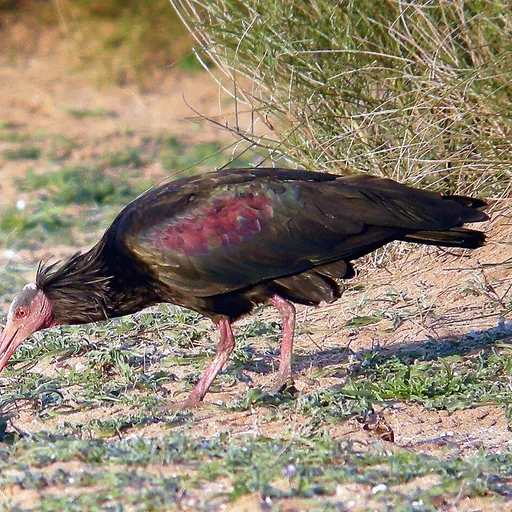
Northern Bald Ibis
Geronticus eremita
Endangered
Overview
The northern bald ibis, Geronticus eremita, is a migratory Old World ibis that inhabits open, arid landscapes such as grasslands, rocky mountains, and semi-deserts. Unlike its wetland-dwelling relatives, it is non-wading and breeds on cliffs or undisturbed ledges. The species is currently classified as Endangered, with wild populations primarily located in Morocco and reintroduction projects underway across Europe and Turkey.
Identification
- A large, glossy black bird measuring 70–80 cm in length with a wingspan of 125–135 cm and bronze-green or violet iridescence.
- Distinctive dull red, unfeathered face and head, paired with a long, curved red bill and red legs.
- In flight, it displays powerful, shallow, and flexible wing beats, with a less rounded wing profile and shorter neck compared to similar species like the glossy ibis.
- Breeding individuals emit guttural hrump and high, hoarse hyoh calls, though they are otherwise silent.
Habitat
The species favours irregularly cultivated, grazed dry areas, including semi-arid steppes, fallow fields, and rocky mountains, often near running water. Historically widespread across the Middle East, northern Africa, and Europe, it is now almost entirely restricted to wild breeding populations in southern Morocco, specifically within Souss-Massa National Park. Reintroduction programmes are also active in Turkey, Austria, Italy, and Spain.
Diet
This gregarious species feeds on a wide variety of animal food, predominantly lizards and tenebrionid beetles, but also small mammals, ground-nesting birds, snails, scorpions, spiders, and caterpillars. It forages in flocks by using its long bill to probe for food items in loose, sandy soil, requiring sparse vegetation no higher than 15–20 cm.
Did you know?
The survival of the Turkish colony was aided by a local belief that the ibis migrated annually to guide Hajj pilgrims to Mecca, a religious significance that afforded the birds protection for centuries. The genus name Geronticus is derived from the Ancient Greek for 'old man', referencing the bird's bald head, while the species name eremita comes from a Latin word for 'hermit', reflecting its preference for desert habitats.
Sources
- Wikipedia · CC BY-SA 4.0
- Wikidata · CC0 1.0