
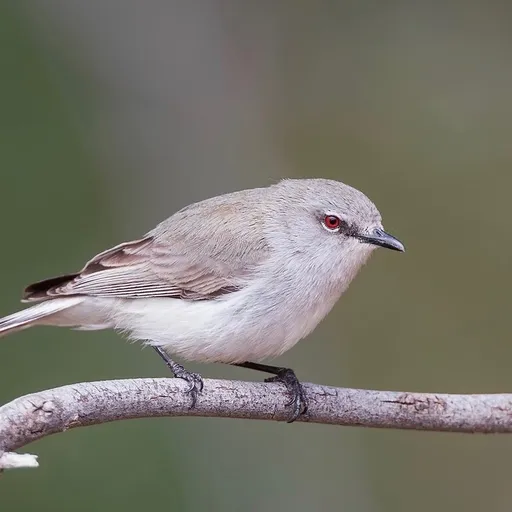
Western Gerygone
Gerygone fusca
Least Concern
Overview
The western gerygone is a small, brownish-grey passerine bird endemic to Australia, found in inland and south-western regions. As an arboreal insectivore, it inhabits open forest, woodland, and dry shrubland, and is classified as Least Concern by the IUCN.
Identification
- Plain, brownish-grey upperparts with no prominent wing markings and whitish underparts that may have variable grey on the throat and breast.
- Distinctive outer tail feathers featuring large white patches at the base, a broad blackish subterminal band, and white tips.
- Characteristic, persistent song consisting of an irregular series of clear, high-pitched whistles with a meandering melody, often recognizable from long distances despite its quiet volume.
Habitat
Endemic to Australia, this species occupies a wide range of wooded habitats, including open sclerophyll forests, mallee, and mulga shrublands, often near watercourses. It is the most widespread gerygone and the only one found in the Australian interior, with populations extending from south-western Western Australia to the Carpentarian Basin and central deserts, though it generally occurs below 850 meters in elevated regions.
Diet
Insectivorous, the western gerygone forages actively in the mid to upper storey of trees and shrubs by probing into bark, gleaning from foliage, hovering, and making aerial strikes from perches. It may also join other small birds in mixed-species feeding flocks.
Did you know?
The population on Rottnest Island, which colonized the area in the 1950s, developed a distinct, strictly repeated song melody that differs from the meandering mainland song, a rare example of cultural innovation and transmission in bird song that may lead to reproductive isolation.
Sources
- Wikipedia · CC BY-SA 4.0
- Wikidata · CC0 1.0