
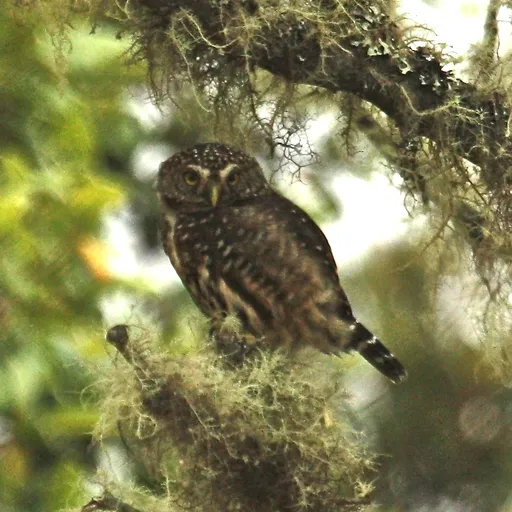
Yungas Pygmy Owl
Glaucidium bolivianum
Least Concern
Overview
The Yungas pygmy owl (Glaucidium bolivianum) is a small owl species in the family Strigidae, native to the eastern slopes of the Andes. It is currently classified as Least Concern by the IUCN, though its population is thought to have declined since its initial description.
Identification
- Approximately 16 cm in length, with males weighing 55-58 g and females averaging 66.5 g.
- Displays three color morphs: rare gray, and common brown and rufous, all featuring pale dots on the crown, back, and upper wings, plus pale tail bands.
- Possesses 'false eyes' on the nape and pale undersides marked with brownish streaks on the flanks and belly.
- Song consists of a rather slow series of equally spaced hollow notes, occasionally preceded by two or three whistled notes.
Habitat
Found in montane forests and cloud forests with heavy undergrowth, moss, and epiphytes, as well as Podocarpus forest, on the eastern Andean slopes of Peru, Bolivia, and northwestern Argentina. Occupies elevations typically between 1,400 and 3,000 m, but ranges from 900 m to 3,900 m, usually residing from mid-levels of the forest into the canopy.
Diet
Primarily nocturnal and crepuscular, this owl forages in the canopy and dense foliage for insects, other arthropods, small birds, and possibly reptiles.
Did you know?
Almost nothing is known about its breeding phenology, but it is believed to nest primarily in old woodpecker holes.
Sources
- Wikipedia · CC BY-SA 4.0
- Wikidata · CC0 1.0