
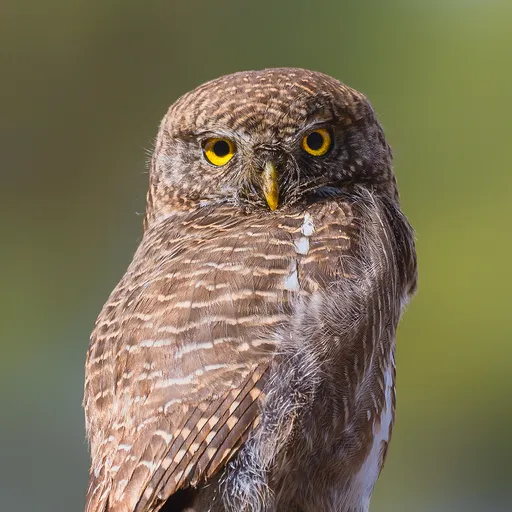
Asian Barred Owlet
Glaucidium cuculoides
Least Concern
Overview
The Asian barred owlet, also known as the cuckoo owlet, is a species of pygmy owl native to the forests and shrublands of mainland Southeast Asia to the foothills of the Himalayas of northern Pakistan. It is a smaller owl measuring 22–25 cm in length, making it one of the larger pygmy owls.
Identification
- Dark brown or olive-brown plumage with dense barring and a white throat patch; the breast and belly are whitish with dark brown bars.
- Unlike most other pygmy owls, they lack false eyes on the back of the head.
- Juveniles feature a streaked breast rather than bars and have a ruddier brown head.
- The male song is a trill lasting 5–20 seconds that grows louder and harsher, often transcribed as "kwuhk kwuhk-ke-kwuhk".
Habitat
This species is widespread in the mainland of Southeast Asia, ranging from southeast China and the Indian subcontinent through to the foothills of the Himalayas in Pakistan. It typically inhabits pine and oak forests, subtropical and tropical evergreen jungles, and submontane regions, though it occasionally occurs in gardens and parks near developed areas.
Diet
Primarily insectivorous, their diet consists of beetles, grasshoppers, and cicadas, supplemented by lizards, small rodents, and small birds. They forage by hunting from a perch and have been observed catching birds such as common quail in mid-air.
Did you know?
In certain regions within their range, owls are perceived as evil omens, which has led to prejudice-driven persecution by shooting, egg collection, and pesticide use, thereby increasing the threat from existing habitat destruction.
Sources
- Wikipedia · CC BY-SA 4.0
- Wikidata · CC0 1.0