
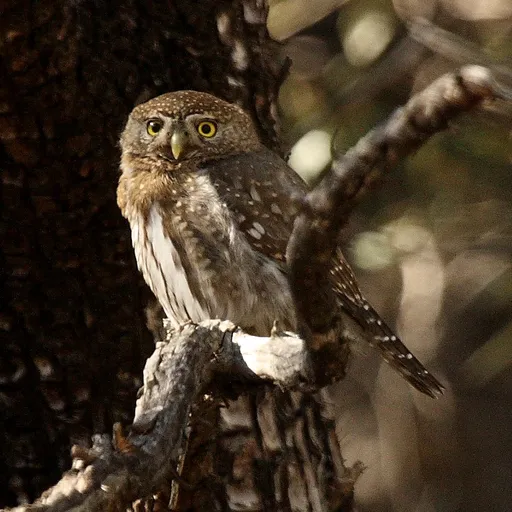
Mountain Pygmy Owl
Glaucidium gnoma
Least Concern
Overview
The mountain pygmy owl, Glaucidium gnoma, is a small owl native to western North America. It is one of several subspecies or species within the Glaucidium gnoma complex, distinguished by its territory and range in mountainous regions.
Identification
- Size: Adults are 15–17 cm (5.9–6.7 in) in overall length.
- Plumage: Gray, brownish-gray, or rufous with a round white-spotted head, weakly defined facial disc, and a white mid-to-lower breast with darker vertical streaking.
- Features: Yellow eyes and a yellowish-green bill; two black nape spots outlined in white on the back of the head that resemble eyes.
- Legs: Feathered down to four well-armed toes on each foot.
- Sound: Unlike other owls, it is not a silent flyer; its wings make a buzzing or whirring sound.
Habitat
Native to Canada, the United States, and Mexico, the species inhabits temperate, subtropical, and tropical moist forests, savannas, and wetlands. Breeding habitat specifically includes open to semi-open woodlands of foothills and mountains in western North America, as well as pure coniferous forests or mixed conifer-deciduous forests.
Diet
These owls are diurnal and act as 'sit-and-wait' predators, though they also hunt actively by moving from perch to perch and swooping down on prey. They consume small mammals, birds, and large insects, including voles, warblers, chickadees, finches, and occasionally prey larger than themselves, such as California quail.
Did you know?
Males are known to be ventriloquistic, perching at the top of the tallest available conifer trees to issue territorial calls, which can cause confusion for observers on the ground trying to locate the bird. They also possess nape eyespots that may discourage predators or redirect mobbing songbirds to attack from the front, allowing the owl to capture them more easily.
Sources
- Wikipedia · CC BY-SA 4.0
- Wikidata · CC0 1.0