
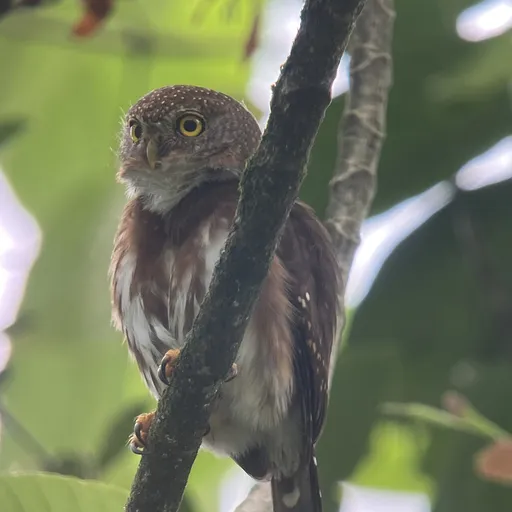
Central American Pygmy Owl
Glaucidium griseiceps
Least Concern
Listen
XC958128 · Beth Cottam · Tres Equis, Turrialba, Provincia de Cartago, Costa Rica · CC0 1.0
Overview
The Central American pygmy owl (Glaucidium griseiceps) is a species of owl in the family Strigidae, assessed as Least Concern by the IUCN. It is found across Central America and parts of Mexico, Colombia, and Ecuador.
Identification
- Length ranges from 13 to 18 cm, with males weighing between 50.6 and 58.8 g and females around 56 g.
- Adults have a grayish brown crown with buff to whitish spots and dark 'false eyes' on the nape; juveniles have a gray, unspotted crown and sooty false eyes.
- Upperparts and tail are rich brown, with pale bars across the tail, while underparts are whitish with reddish brown streaks.
- Song begins with 2–4 equally spaced hoots, followed by a brief pause and a series of 6–18 similar notes, sometimes preceded by trills.
Habitat
This species inhabits lowland and foothill humid tropical evergreen forest, secondary forest, semi-open areas, and mature cacao plantations. Its range extends from southern Mexico through Central America to northwestern Colombia, with a disjunct population in far northwestern Ecuador.
Diet
Though primarily nocturnal, the Central American pygmy owl often hunts during the day. Its diet is poorly understood but is thought to include large insects, other invertebrates, and small lizards, birds, and mammals.
Did you know?
The Central American pygmy owl uses natural cavities or old woodpecker holes for nesting and lays a clutch of two to four eggs in April and May.
Sources
- Wikipedia · CC BY-SA 4.0
- Wikidata · CC0 1.0