
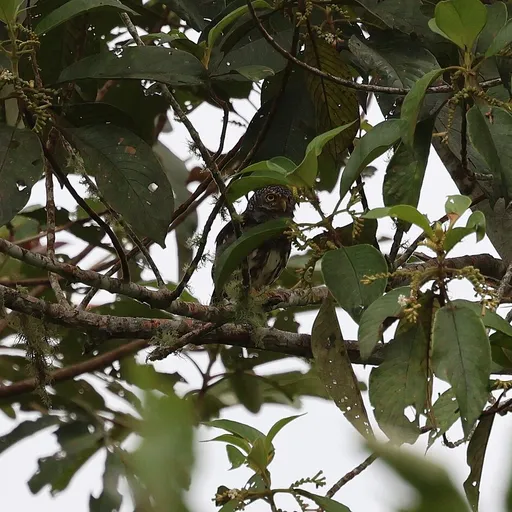
Subtropical Pygmy Owl
Glaucidium parkeri
Least Concern
Overview
The subtropical pygmy owl (Glaucidium parkeri) is a small owl species within the family Strigidae. It inhabits humid montane forests on the eastern slopes of the Andes in South America and is currently assessed as Least Concern by the IUCN.
Identification
- Length of 14 to 14.5 cm with an average weight of approximately 61.6 g.
- Widespread brown morph features a greyish-brown crown with prominent white spots on the crown and sides of the face, alongside a rare rufous morph.
- Dark brown back and rump with a blackish tail marked by spotty white bands; underparts are white with broad dull reddish-olive brown streaks.
- Nape displays black 'false eyes' typical of the genus Glaucidium.
- Vocalisation consists of three or four short phrases of low tone that increase in pitch at the end, described as 'hu-hu, hu', often with a hesitation before the final note.
Habitat
This species is distributed on the eastern slope of the Andes, ranging from far southwestern Colombia through Ecuador and Peru to central Bolivia. It occupies humid montane forest at elevations between 600 and 2,000 m, varying by country.
Diet
The owl is active both during the day and at night. While no specific studies on its feeding habits have been published, its diet is presumed to consist of large arthropods and small vertebrates.
Did you know?
The bird's specific epithet honours Theodore A. Parker III, who accumulated an unparalleled knowledge of Neotropical birds over more than twenty years and graciously shared his expertise with others.
Sources
- Wikipedia · CC BY-SA 4.0
- Wikidata · CC0 1.0