
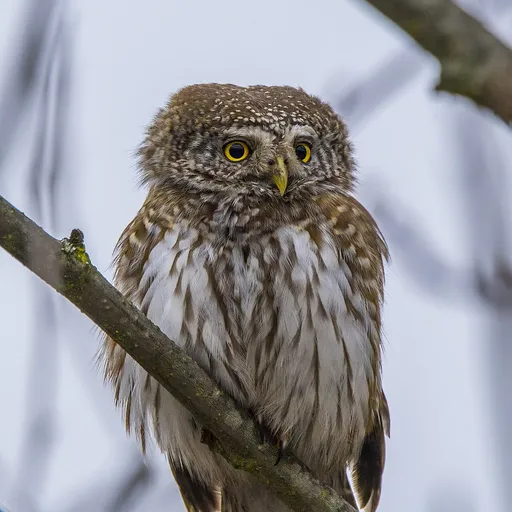
Eurasian Pygmy Owl
Glaucidium passerinum
Least Concern
Listen
XC1038292 · PetrH · Jílové, Děčín District, Ústí nad Labem Region, Czech Republic · CC0 1.0
Overview
The Eurasian pygmy owl (Glaucidium passerinum) is the smallest owl in Europe, distinguished by its sparrow-like size. It is a sedentary species that remains resident throughout the year across its range, with only young birds typically moving in autumn or winter.
Identification
- Red-tinged to greyish-brown plumage with dotted back and a white half-collar around the back of the neck.
- Small, short head lacking ear tufts, featuring white to grey eyebrows, yellow eyes, and a greyish-yellow, hook-shaped beak.
- Females measure 17.4 to 19 cm in length, while males are smaller at 15.2 to 17 cm, both possessing disproportionately large feet and brownish-yellow legs with black talons.
- The male's call is a monotonous chain of clear, fluted notes spaced by approximately two seconds, significantly higher in pitch than a standard owl hoot.
Habitat
This species inhabits the boreal forests of Northern and Central Europe extending to Siberia, primarily occupying coniferous forests of the taiga and higher mountainous regions with cooler temperatures and higher rainfall. It typically resides along the edges of clearings surrounded by moist or swampy land, often near a water source.
Diet
The diet consists mainly of small mammals such as voles, lemmings, bats, and mice, as well as small birds including thrushes, crossbills, chaffinches, and leaf-warblers, which it can catch in flight. It also consumes lizards, fish, and insects, and stores large quantities of prey in autumn to supplement its winter diet.
Did you know?
This owl has evolved disproportionately large feet to enable it to carry larger vertebrate prey despite its small body size. Its food hoarding behaviour is deeply influenced by weather conditions, making the species susceptible to climatic changes.
Sources
- Wikipedia · CC BY-SA 4.0
- Wikidata · CC0 1.0