
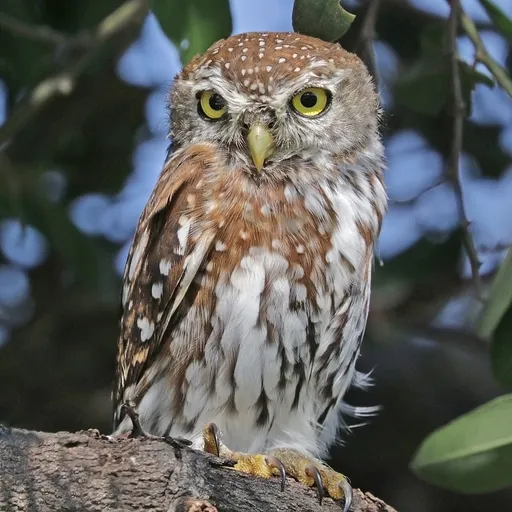
Pearl-spotted Owlet
Glaucidium perlatum
Least Concern
Overview
The pearl-spotted owlet (Glaucidium perlatum) is a small bird of prey native to sub-Saharan Africa. As one of the smallest owls on the continent, it is part of the pygmy owl genus Glaucidium and is currently classified as Least Concern by the IUCN Red List.
Identification
- Length of 17 to 21 cm with a cinnamon-brown upper body covered in distinct white spots.
- Features two striking black false 'eyes' with white outlines at the back of the head, often mistaken for a barred owlet.
- Possesses a pale greenish-yellow bill and cere, with feathered white legs and yellow feet.
- Calls consist of loud, shrill whistles that accelerate in tempo to a crescendo, sometimes performed as a duet by breeding pairs.
Habitat
Found across a wide range of sub-Saharan Africa, from Senegal to Sudan, this species thrives in open thorn savanna, mopane, and sparse ground cover woodland. It avoids dense forests, open grassland, and shrubland, preferring relatively open sites beneath small bushes where it can roost and stake out intruders.
Diet
Predominantly feeding on arthropods such as grasshoppers, crickets, and solifuges, these owlets also capture small vertebrates including rodents, bats, lizards, and small birds. They usually hunt from a low perch at night but will opportunistically forage by day, often being mobbed by other small birds during their activities.
Did you know?
While the pearl-spotted owlet poses no threat to larger vertebrates, Red colobus monkeys in western Uganda have been observed capturing and killing these owlets as an anti-predator behaviour.
Sources
- Wikipedia · CC BY-SA 4.0
- Wikidata · CC0 1.0