
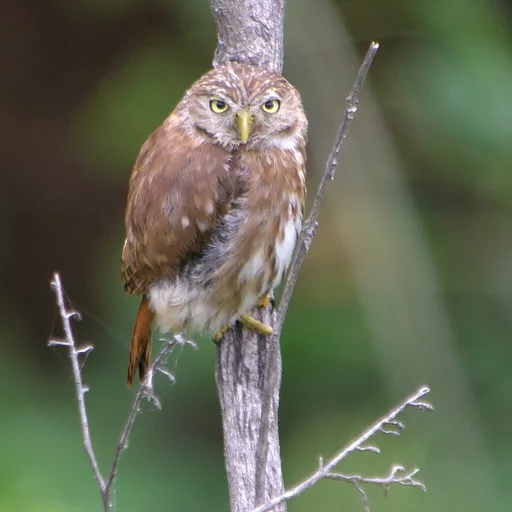
Pacific Pygmy Owl
Glaucidium peruanum
Least Concern
Listen
XC250874 · Niels Krabbe · Azuay: upper Yunguilla Valley, Ecuador · CC BY-SA 4.0
Overview
The Pacific pygmy owl, also known as the Peruvian pygmy owl, is a small typical owl belonging to the subfamily Surniinae. Classified as Least Concern by the IUCN, it is a year-round resident that tolerates human presence when nesting cavities are available.
Identification
- Measuring 15 to 17 cm in length, with males weighing approximately 60 g and females around 65 g.
- Features gray, brown, or rufous color morphs, characterized by an incomplete white 'collar' and oval black spots on the neck that mimic eyes.
- Possesses lemon yellow eyes with a yellow-green bill and feet.
- Vocalisations include rapidly delivered 'pü' notes and rising hoots, such as 'poop'poop'poop'poop'.
Habitat
Found on the western slope of the Andes across Chile, Ecuador, and Peru, extending from sea level to elevations of up to 3,500 m. It inhabits a diverse range of environments, including moist and arid landscapes, deciduous and riparian forests, scrublands, agricultural areas with large trees, and urban gardens.
Diet
This species hunts both during the day and at night, typically foraging from the mid-level to the canopy of forests. Its diet consists of birds, small mammals, other vertebrates, and large arthropods.
Did you know?
Although little is known about its breeding phenology, the owl has been recorded utilising old nests of the pale-legged hornero and even nesting in holes in walls and river banks.
Sources
- Wikipedia · CC BY-SA 4.0
- Wikidata · CC0 1.0