
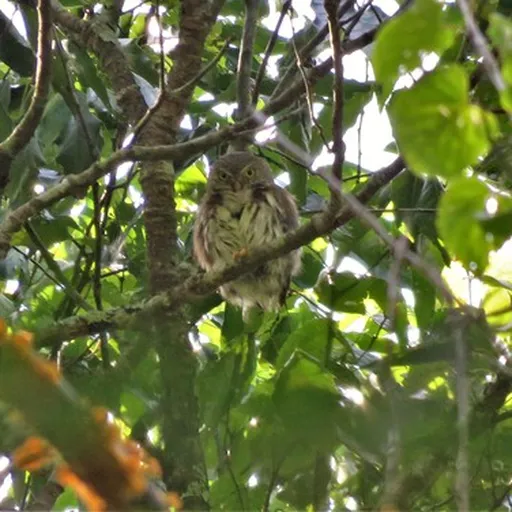
Tamaulipas Pygmy Owl
Glaucidium sanchezi
Near Threatened
Overview
The Tamaulipas pygmy owl (Glaucidium sanchezi) is a species of owl in the family Strigidae that is endemic to Mexico. It is one of the smallest owls in the world, with a mean length of 13.5 cm, though it is slightly heavier than the long-whiskered owlet and the elf owl. The species is currently classified as Near Threatened on the IUCN Red List.
Identification
- Adults measure between 13 and 16 cm in length, with a relatively long tail of 5.1 to 5.7 cm, and average 53 g in weight.
- Males feature a brownish facial disc flecked with white and short white eyebrows, while females exhibit a more reddish-brown appearance overall.
- Upper parts are olive-brown with a greyer crown and fine white speckling; wing and tail feathers are barred in white, and underparts are whitish with reddish-brown streaking and mottling.
- The bill is yellowish-brown, the eyes are yellow, and the legs are feathered.
Habitat
Found exclusively in the mountains of northeastern Mexico, specifically in the northern part of Hidalgo and the southeastern part of San Luis Potosí. The species inhabits moist evergreen forest, montane forest, and cloud forest at altitudes between approximately 900 and 2,100 m.
Diet
This partly diurnal owl feeds on insects and small vertebrates such as lizards.
Did you know?
The Tamaulipas pygmy owl generally chooses a hole in a tree previously used by a woodpecker for nesting. Its chicks are notably precocial, able to fly soon after they emerge from the nest.
Sources
- Wikipedia · CC BY-SA 4.0
- Wikidata · CC0 1.0