
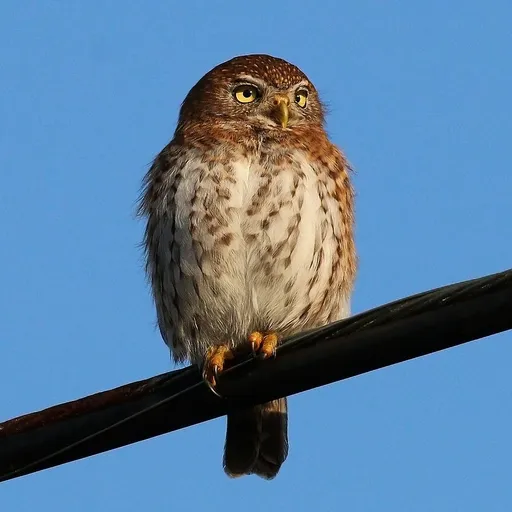
Cuban Pygmy Owl
Glaucidium siju
Least Concern
Overview
The Cuban pygmy owl (Glaucidium siju) is a species of owl endemic to Cuba and belongs to the family Strigidae. It is the most common and frequently observed owl in the country, though it is adversely affected by the destruction of small patches of woodland.
Identification
- 16 to 17 cm long with two color morphs: the common gray-brown and a rufous variant.
- Features a pale grayish face, whitish to cinnamon 'brows' over yellow eyes, and dark 'false eyes' on the nape.
- The gray-brown morph has white-spotted upperparts, brown barred flanks, and an off-white underpart with dark streaks, while the rufous morph replaces gray-brown with cinnamon.
- Males sing a series of equally spaced notes, and both sexes produce a rapid, accelerating alarm call of higher-pitched squeaky notes.
Habitat
The species inhabits the interiors and edges of coastal, deciduous, and montane forests, as well as pastures with scattered trees, cultivated fields, plantations, and large city parks. It ranges in elevation from sea level to 1,500 m. The nominate subspecies is found throughout the main island of Cuba except Pico Turquino, while other subspecies occupy that mountain and the Isla de la Juventud.
Diet
Active during both day and night, the Cuban pygmy owl hunts from a perch. Its diet primarily consists of insects and small reptiles, though it also consumes small mammals, birds, and frogs.
Did you know?
During the dry season from November to April, the species breeds by laying clutches of three or four eggs in tree cavities, often reusing holes previously occupied by woodpeckers.
Sources
- Wikipedia · CC BY-SA 4.0
- Wikidata · CC0 1.0