
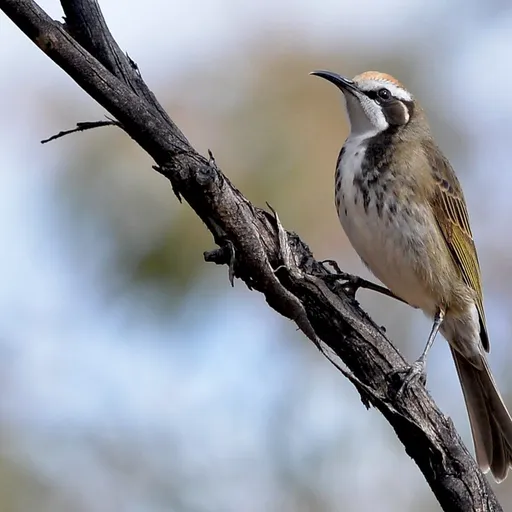
Tawny-crowned Honeyeater
Gliciphila melanops
Least Concern
Overview
The tawny-crowned honeyeater (Gliciphila melanops) is a passerine bird native to southern Australia that belongs to the honeyeater family. It is currently classified as Least Concern on the IUCN Red List, although it has become locally extinct in the urban Sydney area.
Identification
- Features a distinct tawny-coloured crown above a white line that separates the black markings of the face.
- Upper body is pale brown, transitioning to white plumage on the lower parts, with the Tasmanian subspecies exhibiting a rufous tinge.
- Possesses a long curved bill capable of reaching nectar at the base of flowers.
- Resembles the eastern and western spinebills and the crescent honeyeater.
Habitat
Found from the North Coast of New South Wales through to the Eyre Peninsula in South Australia, as well as in Victoria and Tasmania, and from Israelite Bay westwards in southwest Western Australia. Its natural habitat consists of low shrubland and heath.
Diet
Feeds on insects and nectar, using its long curved bill to reach nectar at the base of flowers, where it has become the primary pollinator for some plants. It is observed hopping amongst plants on the ground to feed, a behaviour considered unusual among its near relations.
Did you know?
The specific epithet 'melanops' is derived from Ancient Greek terms meaning 'black face'. The bulky cup-shaped nest is constructed from bark, grass, and even seaweed, often lined with softer material such as fur or wool.
Sources
- Wikipedia · CC BY-SA 4.0
- Wikidata · CC0 1.0