
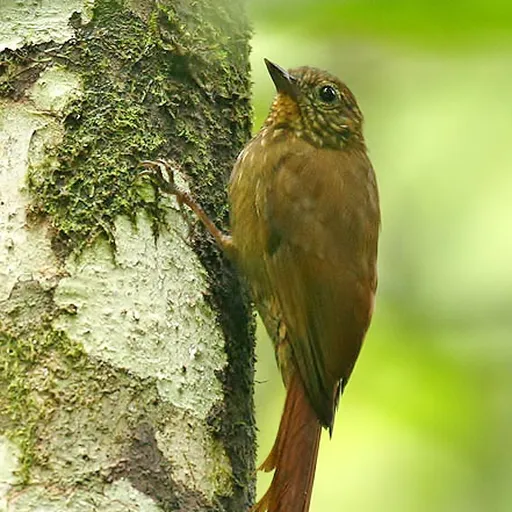
Wedge-billed Woodcreeper
Glyphorynchus spirurus
Least Concern
Listen
XC250204 · Niels Krabbe · El Oro: Reserva Buenaventura 9 km WNW Piñas, Ecuador · CC BY-SA 4.0
Overview
The wedge-billed woodcreeper (Glyphorynchus spirurus) is a sub-oscine passerine bird belonging to the ovenbird family Furnariidae. It is the smallest member of the woodcreeper group and the only species within its genus. Although currently classified as a single species, vocal, plumage, and genetic differences suggest it may actually comprise multiple distinct species.
Identification
- Size: The smallest woodcreeper, measuring 13–16 cm in length and weighing 10.5–21 g.
- Plumage: Generally greyish forehead, russet-brown crown and nape, with cinnamon-rufous tail and lower back; sexes are alike, though subspecies vary in underpart streaking and throat colour.
- Bill: Short, upturned, and distinctly wedge-shaped, resembling those of Xenops species.
- Vocalisation: Sings at dusk and dawn; the pectoralis group produces a rapidly ascending series of bubbly notes, while southeastern populations emit two short, clear whistles.
Habitat
Primarily inhabits tropical evergreen rainforest, favouring the interior of mature primary forest but also found at forest edges and in mature secondary growth. Range extends from southern Mexico through Central America into South America, including the Amazon Basin, the Guianas, and parts of Brazil, Peru, and Bolivia. Elevations vary from near sea level to approximately 2,100 m in Panama and Colombia.
Diet
Feeds almost entirely on very small arthropods, typically foraging in pairs or as part of mixed-species flocks led by antshrikes. It captures prey by hitching up trunks or hugging branches, picking insects from crevices and moss clumps, flaking bark, and hammering on wood.
Did you know?
The wedge-billed woodcreeper demonstrates a lower degree of sensitivity to habitat disturbance than most woodcreepers, as it is able to survive in second growth and forest fragments, although its density tends to decrease in disturbed areas.
Sources
- Wikipedia · CC BY-SA 4.0
- Wikidata · CC0 1.0