
Cajamarca Antpitta
Grallaria cajamarcae
Overview
The Cajamarca antpitta (Grallaria cajamarcae) is a small, plump bird in the family Grallariidae that is endemic to the northwestern Peruvian Andes. Although historically treated as a subspecies of the rufous antpitta, it was returned to full species status in 2021 by the International Ornithological Committee and Clements taxonomy, though some authorities retain it as a subspecies.
Identification
- Length of approximately 14.5 to 15 cm with a stout blackish bill featuring a paler base, and dusky bluish or purplish grey legs and feet.
- Mostly dark reddish yellow-brown crown, upperparts, wings, and tail, with flight feathers showing lighter edges and a pale eyering.
- Underparts are light reddish yellow-brown, with a pale yellowish buff centre to the belly, yellowish brown flanks, and dark yellowish brown undertail coverts; sexes are plumage-identical.
- Long song is a fast series of clear, slightly descending notes around 2.5 kHz that speeds up and rises in pitch towards the end; short song is a slow series of five to six whistled notes, even or slightly downslurred in pitch around 2.2 kHz.
Habitat
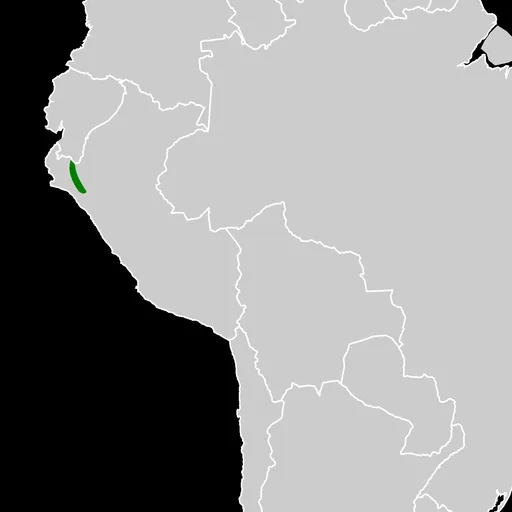
It is found on the west slope of the northwestern Peruvian Andes west of the Huancabamba and upper Marañón rivers, across the Cajamarca, Piura, and Lambayeque departments. Its specific habitat requirements are not fully documented, but it appears to favour the floor and understory of moderately humid cloud forest between 2,850 and 3,400 m in elevation.
Diet
Although its diet and foraging behaviour are formally unknown, it is assumed to be similar to other Grallaria antpittas: it eats arthropods and other invertebrates captured while running or hopping on the forest floor, stopping to turn aside leaf litter and probe the soil for prey.
Did you know?
For most of the twentieth century the Cajamarca antpitta was treated as a subspecies of the rufous antpitta, and two 2020 studies prompted its restoration to full species status in 2021; nonetheless, BirdLife International's Handbook of the Birds of the World still retains it as a subspecies of G. rufula under the English name 'rufous antpitta'.