
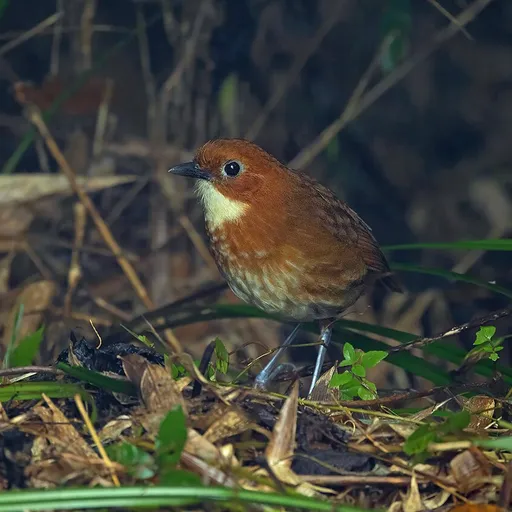
Red-and-white Antpitta
Grallaria erythroleuca
Least Concern
Overview
The red-and-white antpitta (Grallaria erythroleuca) is a species of bird in the family Grallariidae, endemic to Peru. Classified as Least Concern by the IUCN, it is considered uncommon to fairly common and its population is believed to be stable.
Identification
- 17 to 18 cm (6.7 to 7.1 in) long and weighs 73 to 80 g (2.6 to 2.8 oz), with a stout bill and very short tail.
- Adults feature a bright rich rufous crown and nape, often with a ring of bare grayish or bluish gray skin around the eye.
- The back, rump, wings, and tail are a slightly duller, browner rufous than the head, while the throat and centre of the belly are white.
- The breast has rufous-brown sides with white mottling forming a band across it, and the flanks are rufous-brown with an olive wash.
- Adults possess a medium brown iris, a black bill, and slate-gray to blue-gray legs and feet.
- Song typically consists of a three-note hollow whistle with the first note highest, described as "HEE hew-hew", though the Cordillera Vilcabamba population sings four notes.
Habitat
Found on the east side of the Peruvian Andes, mostly in Cuzco Department and slightly into Junín and Ayacucho departments. It inhabits the understory in the interior and edges of humid subtropical montane forest and mature secondary forest, favouring areas with thick regenerating vegetation such as landslide scars and Chusquea bamboo stands. Elevation ranges mostly between 2,100 and 3,000 m (6,900 and 9,800 ft).
Diet
The diet is known to include insects and spiders, though it has not been detailed further. It forages almost entirely on the ground, running and hopping in dense vegetation up to about 1.5 m (5 ft) above the surface, and typically lunges to capture prey from leaf litter and other substrates.
Did you know?
The population in the Cordillera Vilcabamba differs from the rest of the species in some characteristics, potentially representing an undescribed subspecies, and is notable for having a yellow centre to its belly rather than white.
Sources
- Wikipedia · CC BY-SA 4.0
- Wikidata · CC0 1.0