
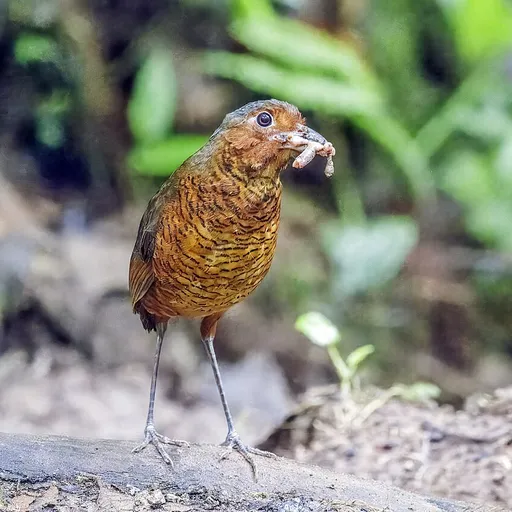
Giant Antpitta
Grallaria gigantea
Vulnerable
Listen
XC248862 · Niels Krabbe · Cotopaxi: Las Palmas, Ecuador · CC BY-SA 4.0
Overview
The giant antpitta (Grallaria gigantea) is a rare and enigmatic perching bird in the antpitta family, native to the montane forests of Colombia and Ecuador. It is currently classified as vulnerable by the IUCN due to ongoing habitat loss and a small population estimated at fewer than 2,500 mature individuals.
Identification
- A large, heavy-bodied bird measuring 24–28 cm in length and weighing up to 300 g, making it the heaviest of all tracheophone suboscine birds.
- Plumage features a dusky olive-brown back, wings, and stubby tail, with a pale to medium grey head and deep rufous-brown body; the throat and breast display dark barring from black-edged feathers.
- The bill is dark, strong, and heavy, while the legs and feet are grey.
- The song consists of low-pitched, fast trills of 14–21 notes per second that rise in pitch and intensity, repeated after irregular pauses.
Habitat
Found in subtropical to temperate moist montane forests across Colombia and Ecuador, with specific subspecies occupying elevations between 1,200 m and above 3,000 m. While occasionally found in cloud forest swamps, pastures, and secondary forest, its survival is heavily dependent on primary forest.
Diet
Its diet is largely composed of terrestrial invertebrates, with large Rhinodrilus earthworms serving as a staple food item, although arthropods are not of key importance. Beetle larvae and slugs have also been recorded as prey, with foraging likely occurring on the ground.
Did you know?
Despite its common name, the giant antpitta is not defined by its reliance on ants, as arthropods are apparently not of key importance to its diet. Instead, it relies heavily on large earthworms, which were observed being fed to fledgling young in a nature refuge in Ecuador.
Sources
- Wikipedia · CC BY-SA 4.0
- Wikidata · CC0 1.0