
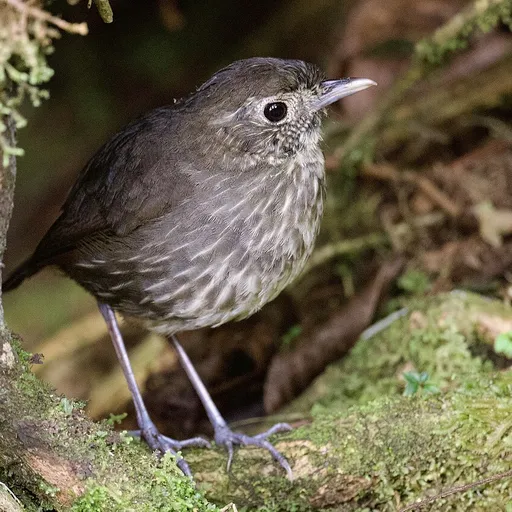
Cundinamarca Antpitta
Grallaria kaestneri
Endangered
Overview
The Cundinamarca antpitta (Grallaria kaestneri) is a small, endangered passerine bird in the family Grallariidae, endemic to Colombia. It inhabits humid montane forests on the eastern slopes of the Andes, specifically within the Cundinamarca and Meta departments. The species is classified as Endangered by the IUCN Red List due to habitat loss and a decreasing population estimated at 330–800 mature individuals.
Identification
- Length of 15 to 16 cm with an average female weight of 47.5 g; sexes are similar in plumage.
- Overall dull olive-brown coloration with faint sooty-black fringes on the back that create the appearance of very faint barring.
- Underparts are olive-brown fading to dull white on the belly, with dull white streaking on the sides and flanks.
- Song consists of three sharp, clear whistled notes sounding like "wirt, wiirt, weert!", while its aggressive call sounds like "SEEleee" with a high-pitched first note.
Habitat
The species is restricted to the eastern slope of Colombia's Eastern Andes, ranging in elevation from 1,700 to 2,500 m. It inhabits humid montane forest and mature secondary woodland, greatly favouring dense vegetation in the understorey, including forest edges and gaps with substantial low vegetation. It appears to have been extirpated from the northern part of its historical range near Monterredondo and the Farallones de Medina.
Diet
The Cundinamarca antpitta feeds almost exclusively on the ground, consuming insects, spiders, and probably earthworms. It forages by hopping and pausing to probe the soil and move leaves to locate prey, seldom flying more than a few metres. Its foraging behaviour suggests it may follow forest mammals such as tapirs.
Did you know?
The species was discovered by Peter Kaestner, an American diplomat who later became the first person in the world to see 10,000 bird species. Despite its small range and Endangered status, the bird is noted for being not particularly shy in its dense habitat, sometimes approaching motionless observers closely.
Sources
- Wikipedia · CC BY-SA 4.0
- Wikidata · CC0 1.0