
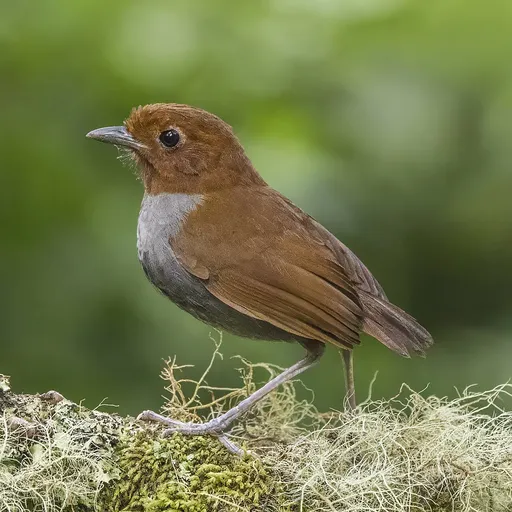
Bicolored Antpitta
Grallaria rufocinerea
Least Concern
Overview
The bicolored antpitta (Grallaria rufocinerea) is a species of bird in the family Grallariidae found in Colombia and Ecuador. Classified as Least Concern by the IUCN, its estimated population of 20,000 to 50,000 mature individuals is currently believed to be decreasing.
Identification
- A plump, round bird measuring 15 to 18 cm in length, with a stout black bill and very short tail.
- Plumage features a rufous-brown or ferruginous red head, throat, upperparts, wings, and tail, contrasting with gray to sooty gray underparts that have a whitish central belly and feather edges.
- The male sings a high, clear, whistled 'treeeee' or 'treeeeeuh', to which the female responds with a repeated 'kree-kree-kree-kree-kree-kree'.
Habitat
The species inhabits the temperate zone of the Central Andes in Colombia and extreme northern Ecuador, primarily residing on the floor and understory of humid montane cloudforest up to the treeline. It also occupies forest edges and secondary forest, ranging from 2,000 to 3,100 m in elevation in Colombia and approximately 2,250 m in Ecuador.
Diet
The bicolored antpitta feeds on earthworms, which appear to form a large part of its natural diet, as well as arthropods. It is an essentially terrestrial forager that has been observed following swarms of army ants and large mammals such as tapirs to capture prey disturbed by their movements.
Did you know?
This bird is one of several antpittas that regularly visit feeding stations set up by observers, where they are provided with earthworms. Despite threats from deforestation for agriculture, it shows some tolerance of habitat degradation and may recolonise areas from where it had previously disappeared.
Sources
- Wikipedia · CC BY-SA 4.0
- Wikidata · CC0 1.0