
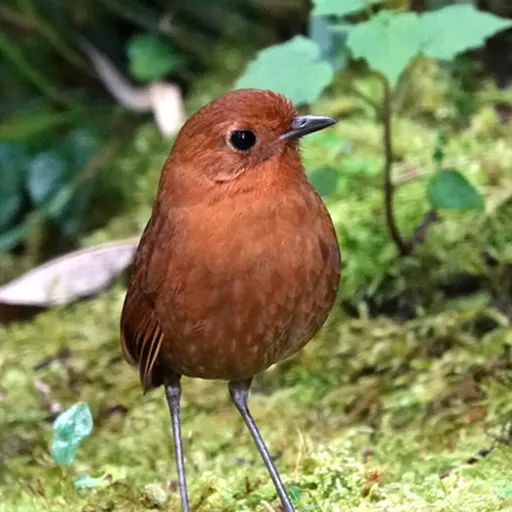
Equatorial Antpitta
Grallaria saturata
Listen
XC248385 · Niels Krabbe · Carchi: Cerro Mongus, Ecuador · CC BY-SA 4.0
Overview
The equatorial antpitta (Grallaria saturata) is a species of bird in the family Grallariidae that is found in Colombia, Ecuador, and Peru. It was originally described as a subspecies of the rufous antpitta but was promoted to full species status in 2020 based on genetic evidence and analysis of vocalizations.
Identification
- Plumage: Mostly rufous-brown upperparts with the sides of the head somewhat more rufous; underparts are rufous with dark gray-brown flanks, a light rufous belly, a buffy white to white vent, and whitish undertail coverts.
- Size: Approximately 14.5 to 15 cm long, weighing 32 to 47 g.
- Bill and Legs: A blackish bill with a paler base to the mandible, and grayish blue to vinaceous gray legs and feet.
- Vocalization: A long song consisting of a rapid, slightly descending trill of short, ringing notes lasting 1.5 to 3.5 seconds, and a short song beginning with a clear note followed by a fast, accelerating stuttering trill.
Habitat
The equatorial antpitta inhabits the floor and understory of humid montane forest heavy with moss and epiphytes, as well as páramo adjacent to forest, forest trails, and bare landslides. It primarily ranges in elevation between 2,500 and 3,300 m, though records exist from 2,200 m to 3,900 m. Its distribution is disjunct, with populations in the Central and Eastern Andes of Colombia, both Andean ranges of Ecuador, and northern Peru.
Diet
The diet consists solely of invertebrates, including arthropods and earthworms. It forages while running or hopping on the forest floor, stopping to reach into leaf litter and probe the soil for prey. The species is known to associate with mixed-species feeding flocks and may follow large mammals like tapirs to catch prey disturbed by their passage.
Did you know?
It is hypothesized that the equatorial antpitta follows large mammals, such as tapirs, to catch invertebrate prey that is disturbed by the animals' passage.