
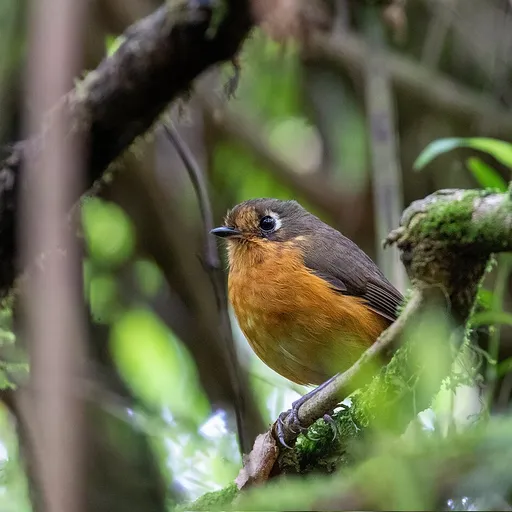
Rufous-breasted Antpitta
Grallaricula leymebambae
Least Concern
Overview
The rufous-breasted antpitta, also known as the Leymebamba antpitta, is a small bird in the family Grallariidae. It was recognised as a full species separate from the rusty-breasted antpitta following a 2018 study, having previously been described as a subspecies in 1933. The species is currently classified as Least Concern by the IUCN.
Identification
- Small Grallaricula antpitta measuring 10 to 12 cm in length and weighing 13 to 21 g, with sexes sharing identical plumage.
- Features an olive brown face marked by a large buffy ochraceous spot on the lores and a white arc behind the eye, with upperparts and wings showing a rufous tinge on the crown.
- Distinctive rich cinnamon ochraceous throat and breast with a white crescent below, a central white belly, a black bill with a white or pinkish base, and pink or dusky gray legs.
- Song consists of a moderate to fast-paced, even-pitched or slightly rising-falling series of whistled notes, transcribed as 'hee-hee-hee-hee-hee-hee-hee-hee', accompanied by descending 'tew' or hollow 'chew' calls.
Habitat
Found in the undergrowth of humid and semi-humid montane forest, favouring areas with thickets, vine tangles, and bamboo. Its distribution is disjunct across Peru, Ecuador, and Bolivia, covering the eastern Andean slopes from the Amazonas Department to La Paz, and the western slopes from Lambayeque to extreme southwestern Ecuador. Elevation ranges between 2,000 and 3,250 m on the east slope and 1,750 to 2,450 m on the west slope.
Diet
The diet includes insects, though specific details are not fully known. Foraging behaviour is assumed to resemble that of the rusty-breasted antpitta, involving hopping through thick vegetation within 2 to 3 m of the ground to glean prey from foliage, mossy branches, and under bark. It occasionally makes short sallies to catch prey and may search leaf litter on the ground.
Did you know?
Nests are constructed as shallow bowls of rootlets, fungal rhizomorphs, and leaf rachides placed on top of a stick platform. These structures are built in small bushes or vine tangles up to approximately 2 m above the ground.
Sources
- Wikipedia · CC BY-SA 4.0
- Wikidata · CC0 1.0