
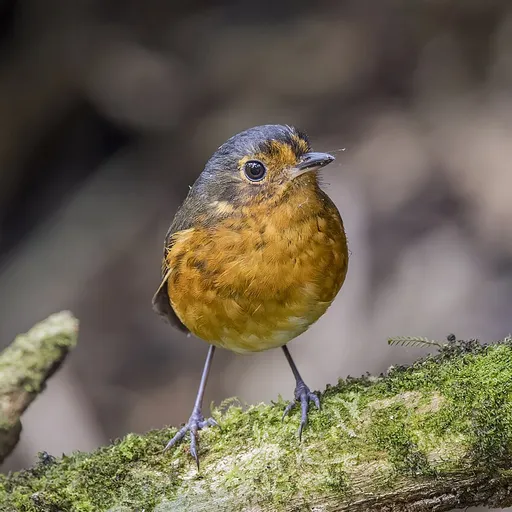
Slaty-crowned Antpitta
Grallaricula nana
Least Concern
Listen
XC248968 · Niels Krabbe · Napo: Cord. de los Guacamayos (2035-2150 m), Ecuador · CC BY-SA 4.0
Overview
The slaty-crowned antpitta (Grallaricula nana) is a small bird in the family Grallariidae. It is found in Brazil, Colombia, Ecuador, Guyana, Peru, and Venezuela.
Identification
- Size: Very small, measuring 10.5 to 11.5 cm (4.1 to 4.5 in) in length and weighing 17.5 to 23 g (0.62 to 0.81 oz).
- Plumage: Sexes are similar; the nominate subspecies features a dark slaty gray crown, olive brown face with an orange rufous loral spot and eyering, dark olive brown upperparts, and orange rufous underparts with a white throat crescent and belly centre.
- Bill and Legs: Possesses a brown iris, a black bill with a white or pinkish base to the mandible, and gray legs and feet.
- Song: Vocalisations vary by subspecies, including sequences like "pee-pee-PEE-pee-pee-pee-pee-pee" in Peru or "we'e'e'ti'ti'ti'ti'ti'ti'ti'ti'ti'ti'te'te'te'e'e'e" in Venezuela, alongside calls such as a descending "tew" or an abrupt "tchew".
Habitat
The species inhabits montane forest in the subtropical to temperate zone, almost always in or near dense stands of Chusquea bamboo. Elevation ranges vary by location, such as 700 to 2,800 m in Venezuela and 2,000 to 3,300 m in Colombia. It is resident throughout its highly disjunct range across South America.
Diet
Its diet includes insects, other arthropods, and earthworms. It typically forages singly or in pairs, hopping through dense foliage and on the ground, gleaning prey from perches or leaf litter. It has also been observed attending swarms of Labidus army ants.
Did you know?
Despite being linked to naturally disturbed areas and dense secondary growth, the species remains reliant on good forest coverage. Its nests are shallow cups of leaves on platforms of sticks, typically placed on the base of bamboo leaves, thin branches, or in vine tangles.
Sources
- Wikipedia · CC BY-SA 4.0
- Wikidata · CC0 1.0