
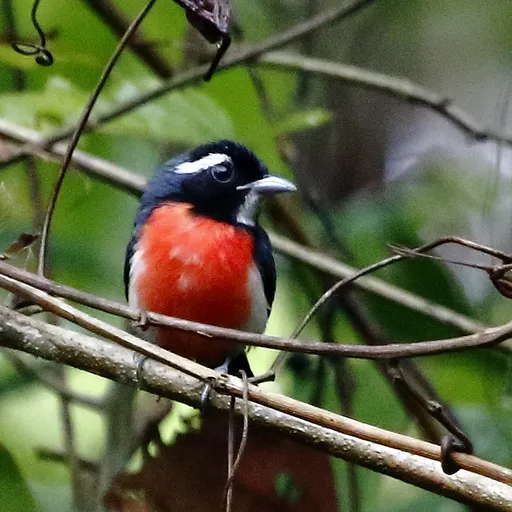
Rose-breasted Chat
Granatellus pelzelni
Least Concern
Overview
The rose-breasted chat is a small passerine bird within the family Cardinalidae, native to the tropical regions of South America. It comprises two subspecies, the nominate Granatellus pelzelni pelzelni and G. p. paraensis, the latter of which may warrant recognition as a separate species.
Identification
- Males display a black head with a white supercilium, blue-gray upperparts, and a rose-red breast and belly separated from the white throat by a thin black line.
- Females feature blue-gray upperparts and a black tail, with rich buff coloring on the face, breast, and flanks, and white on the throat and belly.
- The species is compact, measuring 12 to 12.5 cm in length and weighing between 10 and 12.5 g.
- The song of the nominate subspecies consists of 5–6 clear, sweet notes on a single pitch, while calls include a repeated 'jrrt'.
Habitat
This species inhabits tropical rainforest and its edges, frequently occurring near rivers or lagoons within the forest interior. The nominate subspecies also utilises drier deciduous and mature secondary forests, mostly at low elevations, though it reaches up to 850 m in southern Venezuela. Its range extends from eastern Colombia and Venezuela through the Guianas to eastern Brazil and northern Bolivia.
Diet
The nominate subspecies feeds primarily on insects and other invertebrates, gleaned from foliage or caught by sallying after flying prey. Foraging typically occurs at middle to high levels, although it occasionally uses the understory and may join mixed-species flocks during the non-breeding season.
Did you know?
The subspecies G. p. paraensis is suspected to lose 22–25% of its suitable habitat within its distribution over a period of three generations.
Sources
- Wikipedia · CC BY-SA 4.0
- Wikidata · CC0 1.0