
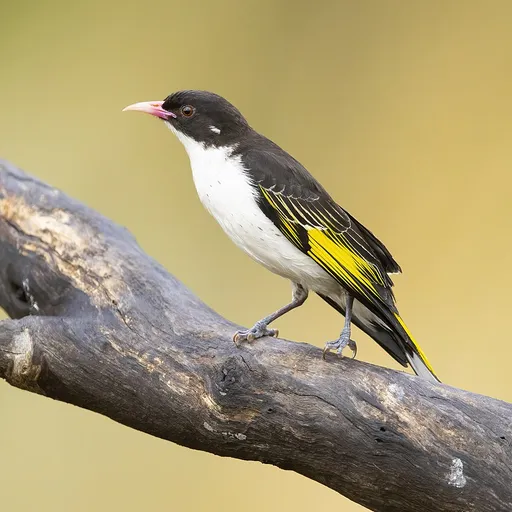
Painted Honeyeater
Grantiella picta
Least Concern
Overview
The painted honeyeater (Grantiella picta) is a small, nomadic honeyeater endemic to Australia, belonging to a monotypic genus. As a dietary specialist and frugivore, its survival and distribution are closely linked to the availability of mistletoe berries.
Identification
- Adult males feature a striking contrast of black upperparts with small white head spots and white underparts, set against a pink bill with a grey tip.
- Flight feathers and tail feathers have bright yellow edges, with the tail also showing white tips, creating a distinctive painted appearance.
- Females are slightly smaller and paler than males, while juveniles are browner with fainter yellow markings and a grey bill.
- The bird is most commonly identified by its two-note call, typically transcribed as 'Georgie' or 'geor-gie'.
Habitat
Found in woodlands and forests containing Eucalyptus and Acacia species, the species is endemic to eastern and northern Australia. Its range extends from inland central Victoria through New South Wales, the ACT, and southern Queensland in spring and summer, with birds migrating north to Queensland and the Northern Territory in winter.
Diet
Primarily a frugivore, the painted honeyeater depends on the berries of at least five species of Amyema mistletoe, assisting in seed dispersal through excretion. Nectar and insects are also consumed, particularly when berries are scarce or to supplement the low amino acid and protein content of the fruit.
Did you know?
During nest construction, the male follows the female to the top of the tree whenever she leaves to collect material, an aggressive guarding behaviour intended to keep other interested males away from her.
Sources
- Wikipedia · CC BY-SA 4.0
- Wikidata · CC0 1.0