
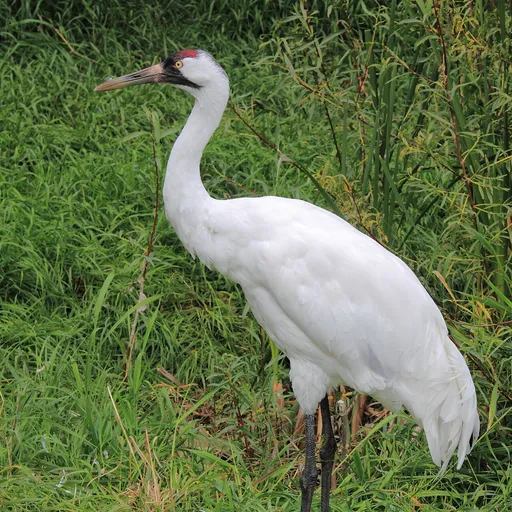
Whooping Crane
Grus americana
Endangered
Overview
The whooping crane (Grus americana) is an endangered crane species native to North America, distinguished by its loud, whooping calls. It is the tallest bird native to the continent, with an estimated wild life expectancy of 22 to 30 years or more.
Identification
- Adults feature white plumage with a red crown, whereas immatures are cinnamon brown.
- They stand 1.24 to 1.6 m tall, with a wingspan of 2 to 2.3 m and a long, dark, pointed bill.
- In flight, the long necks remain straight and dark legs trail behind, revealing black wing tips on adults.
- Calls are loud enough to carry several kilometres, including rhythmic 'unison calls' used by pairs.
Habitat
Historically found throughout midwestern North America and Mexico, the current remnant population migrates between the muskeg of the taiga in Wood Buffalo National Park, Canada, and the coastal Gulf of Texas in the United States. Reintroduced populations now breed in Wisconsin and Louisiana, though efforts in Florida have been halted due to high mortality.
Diet
These omnivorous birds forage in shallow water or fields by probing with their bills, favouring animal material over most other crane species. Their diet includes crustaceans, mollusks, fish, small reptiles, rodents, and various aquatic plants and fruits, with blue crabs being a significant food source in Texas.
Did you know?
Individuals can be identified in the wild through 'voiceprints', a technique that analyses the frequency of their guard and unison calls, which successfully identified a crane as being over 26 years old even after it had lost its leg band.
Sources
- Wikipedia · CC BY-SA 4.0
- Wikidata · CC0 1.0