
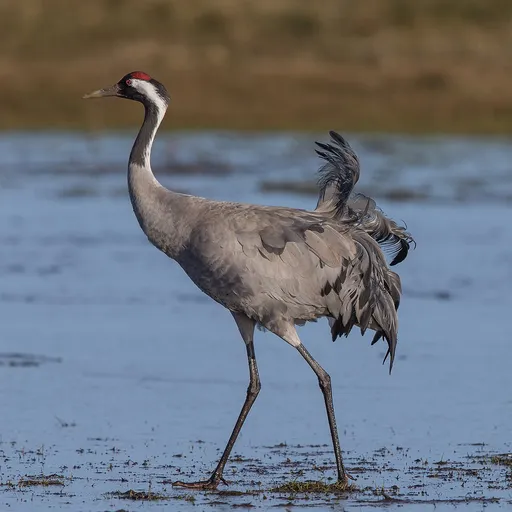
Common Crane
Grus grus
Least Concern
Listen
XC878993 · wilmet sebastien · Arrondissement de Verdun (near Sommedieue), Meuse, Grand Est, France · CC0 1.0
Overview
The common crane (Grus grus), also known as the Eurasian crane, is a medium-sized species in the family Gruidae and the only crane commonly found in Europe besides the demoiselle crane. It is classified as Least Concern on the IUCN Red List, though it has experienced local extinctions in parts of its range.
Identification
- Slate-grey overall plumage with a blackish forehead and lores, and a bare red crown topped by a white streak extending from behind the eyes to the upper back.
- A large, stately bird measuring 100–130 cm in length with a wingspan of 180–240 cm.
- A loud, piercing trumpeting call that can be heard from a considerable distance, often given during flight or display.
- Adult greater coverts droop into distinctive explosive plumes, while juveniles have yellowish-brown feather tips and a fully feathered crown.
Habitat
The species breeds in boreal and taiga forests, mixed forests, and treeless moors across Europe and the Palearctic, requiring quiet environs with minimal human interference. During winter, it moves to flooded areas, shallow sheltered bays, swampy meadows, and open cultivated lands in southern Europe, Africa, and Asia. Breeding populations are concentrated in Russia, Finland, and Sweden, with birds migrating to winter in Portugal, Spain, and northern Africa.
Diet
An omnivore, the common crane largely consumes plant matter such as roots, rhizomes, tubers, stems, leaves, fruits, and seeds, including pond-weeds, heath berries, and acorns. Animal foods, including insects, snails, earthworms, crabs, fish, amphibians, rodents, and small birds, become primary during the summer breeding season. They forage on land or in shallow water by probing with their bills, often in small groups or winter flocks.
Did you know?
Common cranes are among the highest-flying birds, reaching altitudes of up to 10,000 m during migration, a height second only to that of the Ruppell's vulture.
Sources
- Wikipedia · CC BY-SA 4.0
- Wikidata · CC0 1.0