
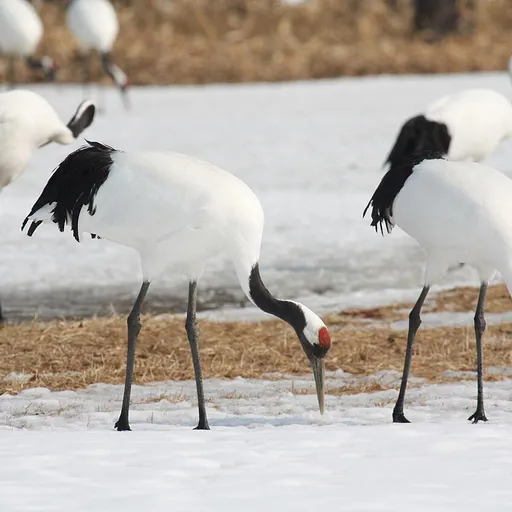
Red-crowned Crane
Grus japonensis
Vulnerable
Overview
The red-crowned crane, also known as the Japanese or Manchurian crane, is a large Northeast Asian bird among the rarest cranes in the world. It is classified as Vulnerable on the IUCN Red List, with populations split between a migratory continental group and a resident population in Hokkaidō, Japan. In parts of its range, the species is regarded as a symbol of luck, longevity, and fidelity.
Identification
- Plumage: Snow white body with black wing secondaries that resemble a black tail; adult males have black cheeks, throat, and neck, while females have pearly grey markings in these areas.
- Head: Features a distinct patch of red bare skin on the crown that brightens during the mating season.
- Structure: The bill is olive green to greenish horn, legs are slate to greyish black, and the iris is dark brown.
- Size: Among the heaviest cranes, typically measuring 150 to 158 cm tall with a wingspan of 220–250 cm and a weight range of 4.8 to 10.5 kg.
Habitat
This species nests in wetlands, marshes, and rivers across Siberia, Northeast China, and occasionally north-eastern Mongolia, with a resident population in eastern Hokkaidō. Migratory populations move to the Korean Peninsula and east-central China for the winter, where they utilise paddy fields, grassy tidal flats, and mudflats.
Diet
Possessing a highly omnivorous diet with a strong preference for carnivory, these cranes eat fish, amphibians, snails, crabs, insects, and small mammals, alongside plants such as rice, reeds, and grasses. They forage in wet grasslands and shallow waters by jabbing their beaks into the mud or striking rapidly to capture slippery prey, often tearing larger items apart by shaking them vigorously.
Did you know?
Despite the belief that they mate for life, red-crowned cranes exhibit intense territorial aggression even while roosting, maintaining a minimum distance of 2 to 3 metres from unrelated individuals to stay out of pecking range, which can lead to violent attacks if boundaries are violated. They are also capable of inflicting painful injuries on humans using their dagger-like beaks and feet.
Sources
- Wikipedia · CC BY-SA 4.0
- Wikidata · CC0 1.0