
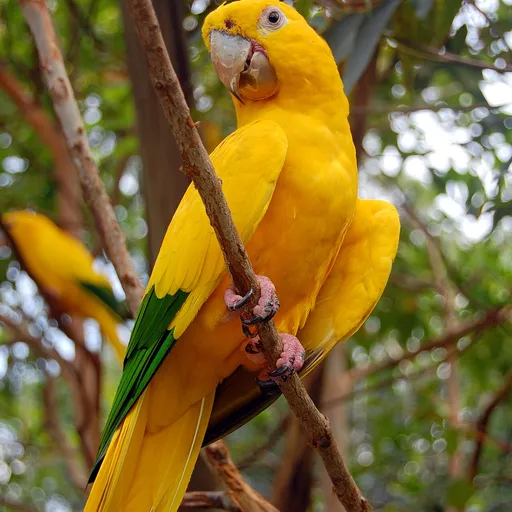
Golden Parakeet
Guaruba guarouba
Vulnerable
Overview
The golden parakeet, also known as the golden conure or Queen of Bavaria conure, is a medium-sized, golden-yellow Neotropical parrot native to the Amazon Basin of interior northern Brazil. It is the only species placed in the genus Guaruba and is currently listed as vulnerable on the IUCN Red List.
Identification
- Adults are 34–36 cm long with predominantly bright yellow plumage, green outer wings, and an all-yellow tail.
- Features include a large horn-colored bill, pale-pink bare eye rings, brown irises, and pink legs.
- Juveniles appear duller with more green plumage on the head, neck, and back, and have pale-gray eye rings and brown legs.
Habitat
The species inhabits drier, upland rainforests in Amazonian Brazil, with a range estimated between the Tocantins, lower Xingu, and Tapajós Rivers in the state of Pará. During the non-breeding season, they occupy tall forests, but shift to open agricultural fields at the forest edges during the breeding season.
Diet
This social species feeds on a varied diet of fruits such as mango, muruci, and açaí, as well as flowers, buds, seeds, and crop plants like maize.
Did you know?
The golden parakeet exhibits a breeding system that is almost unique amongst parrots, where pairs are aided by helpers who assist in raising the young. In captivity, however, these birds often resume breeding immediately when their chicks are removed from the nest.
Sources
- Wikipedia · CC BY-SA 4.0
- Wikidata · CC0 1.0