
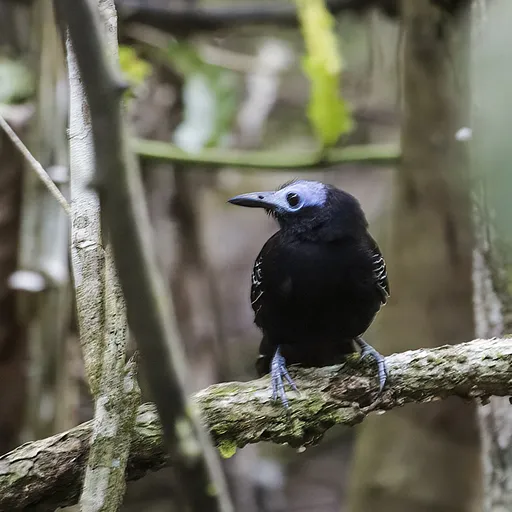
Bare-crowned Antbird
Gymnocichla nudiceps
Least Concern
Overview
The bare-crowned antbird (Gymnocichla nudiceps) is a species of bird in the family Thamnophilidae, known as the typical antbirds. It is the only member of its genus and is classified as Least Concern by the IUCN, although its population is believed to be decreasing.
Identification
- Size: 15 to 17 cm long, weighing 28 to 33 g.
- Plumage: Adult males of the nominate subspecies are almost entirely black with white-tipped wing coverts and tail feathers; females have dark yellowish-brown upperparts with a white interscapular patch and cinnamon-rufous underparts.
- Markings: Males possess bright blue bare skin on the forehead, forecrown, lores, and around the eyes; females have the same blue skin only on the lores and around the eyes. Both sexes have red irises and grey legs.
- Vocalisation: The male sings a series of clear, sweet whistles that rise in the middle and accelerate at the end, often accompanied by tail vibration; females join in with a similar song.
Habitat
Found across Belize, Colombia, Costa Rica, Guatemala, Honduras, Mexico, Nicaragua, and Panama, the species inhabits dense understory vegetation in lowland and foothill evergreen forests. It primarily occurs at the edges of primary forest, in secondary forest, clearings, and old plantations with regenerating vegetation, often in swampy areas or along stagnant streams. Its elevation range varies from sea level to 250 m in most of Central America, rising to 1,200 m in Costa Rica and Panama.
Diet
The diet consists of a variety of insects such as cockroaches, beetles, ants, and grasshoppers, as well as other arthropods like spiders and small lizards. It forages singly, in pairs, or in family groups in dense vegetation, mostly on the ground or within 2.5 m above it, hopping between feeding stops and bobbing its tail. Prey is captured by gleaning, reaching, jumping, and lunging from a perch, and the bird regularly follows army ant swarms to catch disturbed prey.
Did you know?
Despite being primarily a bird of second-growth habitats, its survival is threatened by the conversion of native forest to cattle pasture and intensive agriculture, which prevents the formation of the mature second growth it requires. Both parents provision the nestlings, with the male often observed flushing from the nest while the female broods.
Sources
- Wikipedia · CC BY-SA 4.0
- Wikidata · CC0 1.0