
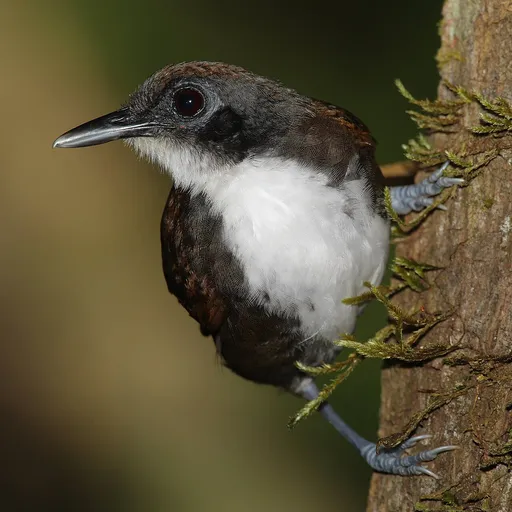
Bicolored Antbird
Gymnopithys bicolor
Least Concern
Listen
XC250913 · Niels Krabbe · Pichincha: Río Guaycuyacu, Ecuador · CC BY-SA 4.0
Overview
The bicolored antbird (Gymnopithys bicolor) is a species of bird in the family Thamnophilidae, commonly known as the typical antbirds. It is an obligate ant follower that inhabits lowland and foothill forests across Central and northern South America.
Identification
- Length of 13.5 to 15 cm and weight of 28 to 37 g, with sexes appearing identical in plumage.
- Adults of the nominate subspecies possess a brownish chestnut crown, nape, back, wings, and tail, contrasting with a white throat and breast crossed by a brown band.
- Facial markings include a gray forehead, a broad gray band behind the eye, black cheeks, and bare blue-gray skin around the eye.
- Primary song consists of high notes that increase in pitch and pace before slowing and descending, accompanied by calls such as a harsh 'chirr' and abrupt 'chup' notes.
Habitat
Found in Colombia, Costa Rica, Ecuador, Honduras, Nicaragua, and Panama, the species primarily inhabits lowland and foothill terra firme evergreen forest and nearby mature secondary forest. It remains almost entirely within the forest undergrowth, reaching elevations of up to 1,750 m in parts of Central America but lower in other regions.
Diet
As an obligate ant follower, it feeds on a wide variety of arthropods that flee foraging army ant swarms. It typically forages individually, in pairs, or in family groups, perching near the ground or sallying down to capture prey.
Did you know?
The species was only recognized separately by the IUCN Red List in 2016, following a 2007 genetic study that showed it was distinct from the similar white-cheeked antbird.
Sources
- Wikipedia · CC BY-SA 4.0
- Wikidata · CC0 1.0