
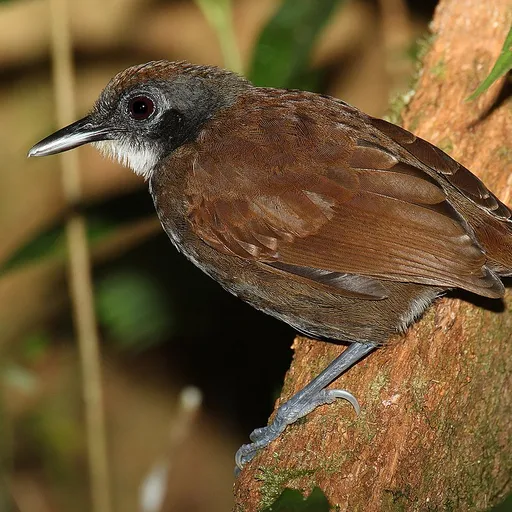
White-cheeked Antbird
Gymnopithys leucaspis
Least Concern
Listen
XC250910 · Niels Krabbe · Napo: Napo Galeras, Ecuador · CC BY-SA 4.0
Overview
The white-cheeked antbird (Gymnopithys leucaspis) is an insectivorous bird belonging to the family Thamnophilidae, commonly known as the typical antbirds. It is classified as Least Concern on the IUCN Red List and is considered fairly common across its range in South America.
Identification
- Measures 13.5 to 15 cm in length and averages 24 g in weight.
- Adult males feature a chestnut-brown crown, back, wings, and tail with rufous edging, contrasting with white cheeks, throat, and breast.
- Distinctive bare blue skin surrounds the eye, and a blackish band runs from the lores through the eye down the neck and flanks.
- Females share the male plumage but have an additional cinnamon patch between the scapulars, while juveniles possess brownish underparts before white feathers emerge.
Habitat
Found in Brazil, Colombia, Ecuador, and Peru, the species primarily inhabits humid lowland and foothill terra firme evergreen forest and nearby mature secondary forest. It remains almost entirely in the forest undergrowth and reaches elevations of up to 1,000 m in Colombia and 750 m in Ecuador and Peru.
Diet
As an obligate ant follower, it feeds on a wide variety of arthropods fleeing army ant swarms, as well as small frogs and lizards. The bird typically forages individually, in pairs, or in family groups, perching within about 1 m of the ground or as high as 5 m and sallying or pouncing to the ground to capture prey.
Did you know?
Although Philip Sclater initially described the bird in 1855 as Myrmeciza leucaspis, it retained the specific epithet leucaspis even after being moved to the genus Gymnopithys due to the principle of priority, despite earlier being confused with the bicolored antbird.
Sources
- Wikipedia · CC BY-SA 4.0
- Wikidata · CC0 1.0