
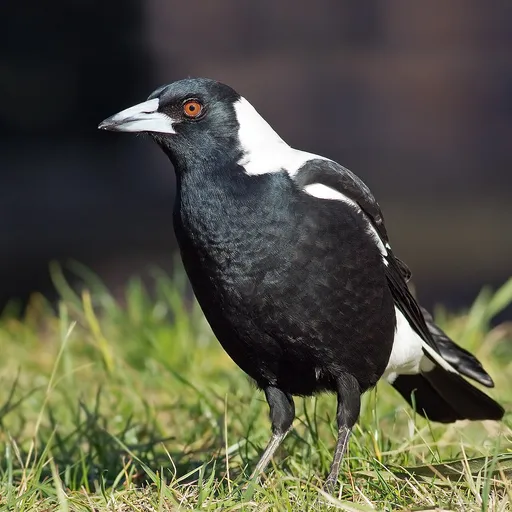
Australian Magpie
Gymnorhina tibicen
Least Concern
Listen
XC726066 · Richard Fuller · Carindale, Brisbane City, Queensland, Australia · CC0 1.0
Overview
The Australian magpie (Gymnorhina tibicen) is a robust passerine bird native to Australia and southern New Guinea, and introduced to New Zealand and the Fijian island of Taveuni. Although once considered to be three separate species, it is now recognised as a single species with nine subspecies. It is a member of the family Artamidae and is most closely related to the black butcherbird (Melloria quoyi).
Identification
- Ranges from 37 to 43 cm in length with a wingspan of 65–85 cm, weighing 220–350 g, and possessing long, strong black legs that allow it to walk rather than hop.
- Plumage is pure glossy black and white, with black heads, wings, and underparts, white shoulders, and a tail featuring a black terminal band; males have a pure white nape while females have a light greyish-white one.
- The bill is a robust, wedge-shaped bluish-white structure bordered with black, featuring a small hook at the tip.
- Mature individuals have dull red eyes, distinguishing them from the yellow-eyed currawong and white-eyed Australian ravens and crows.
Habitat
The species is found across most of Australia, excluding the tip of Cape York and the Gibson and Great Sandy Deserts, as well as in the Trans-Fly region of southern New Guinea. It has also been introduced to New Zealand, the Solomon Islands, and Fiji. As a generally sedentary and territorial bird, it has adapted well to human habitation and is common in parks, gardens, and farmland.
Diet
The Australian magpie is omnivorous, with the bulk of its varied diet consisting of invertebrates. It spends much time on the ground foraging and is commonly fed by households around Australia.
Did you know?
Research has shown that magpies can recognise at least 100 different people and may be less likely to swoop individuals they have befriended. They are also capable of mimicking over 35 species of native and introduced birds, as well as dogs, horses, human speech, and environmental sounds such as emergency vehicles.
Sources
- Wikipedia · CC BY-SA 4.0
- Wikidata · CC0 1.0