
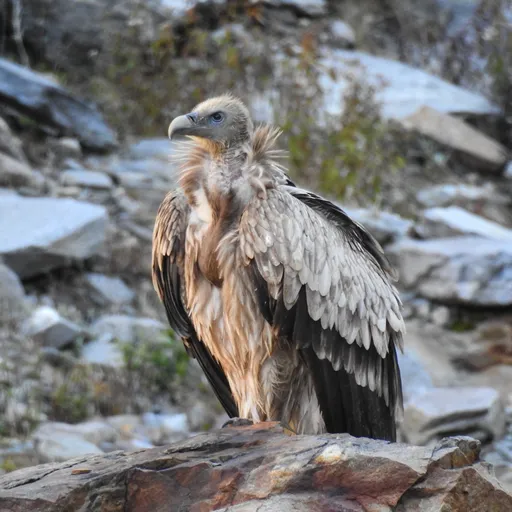
Himalayan Vulture
Gyps himalayensis
Near Threatened
Overview
The Himalayan vulture (Gyps himalayensis), also known as the Himalayan griffon vulture, is an Old World vulture native to the Himalayas and the Tibetan Plateau. It is the second-largest Old World vulture species after the cinereous vulture and is listed as Near Threatened on the IUCN Red List.
Identification
- Plumage: Pale buff uniform upperside with dark brown greater coverts, tail, and wing quills; underside and under-wing coverts are pale brown or buff, sometimes almost white.
- Head: Adults possess a long, pale brown ruff with white streaks and long, spiky feathers; facial skin is pale blue, lighter than in the Eurasian griffon vulture.
- Bill: Yellowish and stouter than that of the Indian vulture.
- Size: Ranges from 6 to 12.5 kg in weight with a wingspan of 2.56 to 3.1 m, making it perhaps the largest and heaviest bird in the Himalayas.
Habitat
This species inhabits the higher regions of the Himalayas and the Tibetan Plateau at elevations between 1,200 and 5,500 m. Its distribution spans from Central Asia through North and Northeastern India, Nepal, Bhutan, and western China to Mongolia, with occasional vagrants recorded in Southeast Asia.
Diet
Himalayan vultures are scavengers that feed exclusively on carrion, largely ignoring offal in favour of fleshy tissue. They often follow grazers up the mountains to locate dead animals and can strip a carcass of all tissue in as little as 30 minutes when feeding in a large group. Historically, they also fed on human corpses left out for celestial burials.
Did you know?
These vultures have been observed feeding on pine needles, an unexplained behaviour that is not for nutrition but may provide access to essential oils and terpenes for digestive or immunity benefits.
Sources
- Wikipedia · CC BY-SA 4.0
- Wikidata · CC0 1.0