
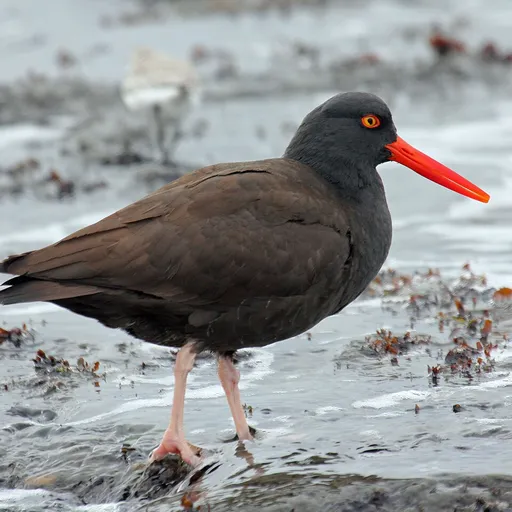
Black Oystercatcher
Haematopus bachmani
Overview
The black oystercatcher, Haematopus bachmani, is a large shorebird found on the shoreline of western North America, ranging from the Aleutian Islands of Alaska to the coast of the Baja California peninsula. It is the only representative of the oystercatcher family over most of its range, overlapping slightly with the American oystercatcher in Baja California.
Identification
- Plumage: Black head, neck, and breast with a dark brown body; plumage is darker further north.
- Bill and Legs: Possesses a long (9 cm) bright red/orange bill and pink legs.
- Eyes: Features a bright yellow iris and a red eye-ring.
Habitat
Restricted to coastal stretches, the species never strays far from shores, favouring rocky shorelines with quieter embayments such as jetty-protected areas. It is a keystone indicator species along the north Pacific shoreline.
Diet
Foraging in the intertidal zone, the bird feeds on marine invertebrates, particularly molluscs such as mussels, limpets, and chitons, as well as crabs, isopods, and barnacles. It uses its strong bill to dislodge food and pry shells open, often flying up to avoid crashing surf when searching close to the water's edge.
Did you know?
Nests are constructed as small bowls or depressions close to the shore, into which small pebbles and shell fragments are tossed with a sideward or backward flick of the bill. The eggs are very hard and can even survive being submerged by a high tide or very high water levels.