
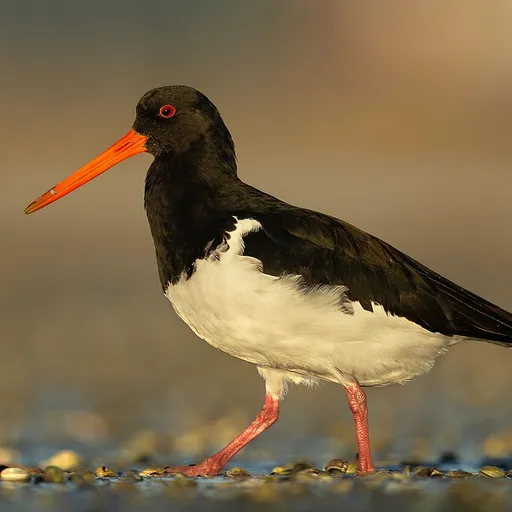
South Island Oystercatcher
Haematopus finschi
Least Concern
Overview
The South Island oystercatcher, or South Island pied oystercatcher (Haematopus finschi), is one of two common oystercatcher species found in New Zealand. It is a large wader that breeds inland on the South Island before moving to coastal areas on the North Island. The species is listed as Least Concern on the IUCN Red List.
Identification
- Large wader with striking black and white plumage, measuring 46 cm in length with a wingspan of 80–86 cm.
- Possesses a long red-orange bill and red legs.
- Distinguished from similar species by a white lower back, more white on the wing, and a demarcation line of black and white further forward on the breast.
- Vocalisations include piping calls used for social and aggressive interactions, a piercing alarm call, and a quiet flight call.
Habitat
Endemic to New Zealand, this species breeds inland on the South Island in braided river systems, open paddocks, cultivated land, lake beaches, subalpine tundra, and herb fields. After the breeding season, most of the population migrates to estuaries and harbours on the North Island, where non-breeding habitats include coastal estuaries, bays, beaches, sand flats, and intertidal mudflats.
Diet
The South Island oystercatcher feeds primarily on mollusks and worms, with the New Zealand cockle (Austrovenus stutchburyi) being a major food source. It is estimated that an individual can consume approximately 200,000 cockles in a single year.
Did you know?
The species is host to the flatworm Curtuteria australis, whose life cycle involves a complex loop where larvae in cockles are eaten by the oystercatchers, excreted, injected into whelks by the birds, and finally consumed by cockles. The common acronym for the bird is 'SIPO', which rhymes with 'typo'.
Sources
- Wikipedia · CC BY-SA 4.0
- Wikidata · CC0 1.0