
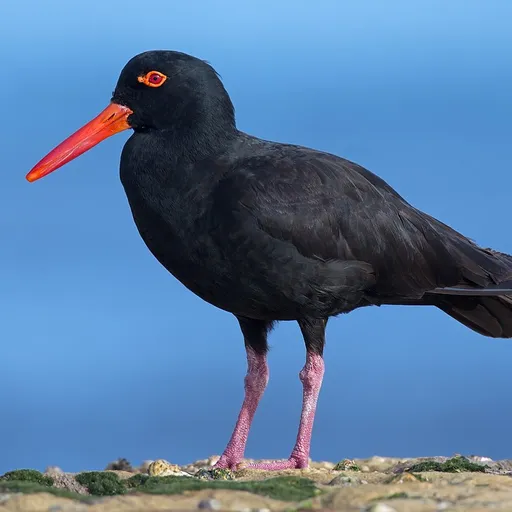
Sooty Oystercatcher
Haematopus fuliginosus
Least Concern
Overview
The sooty oystercatcher (Haematopus fuliginosus) is a wading bird endemic to Australia, commonly found on rocky coastlines and occasionally in estuaries. It is the heaviest of all oystercatchers, with females being larger and heavier than males.
Identification
- All black plumage, with scarlet or orange-red eyes, eye rings, and bills.
- Pink-red legs, measuring 42 to 52 cm in length, making it the heaviest oystercatcher.
- Females have longer, thinner bills, while males have shorter, thicker bills, with a 19% average difference in length.
- Immature birds have grey-brown legs, a bill tipped with brown, and brown eyes, which turn red by the second year.
Habitat
The sooty oystercatcher is endemic to Australia, preferring rocky shores and occasionally estuaries. It is common around the Tasmanian coastline and Bass Strait islands but is declared Rare in South Australia and Queensland, Near Threatened in Victoria, and Endangered in New South Wales. There are two subspecies: the nominate from southern Australia and ophthalmicus from northern Australia.
Diet
The sooty oystercatcher forages in the intertidal zone for two hours either side of low tide. Females focus on soft-bodied prey such as fish, crabs, jellyfish, and worm-like creatures, while males prefer hard-shelled prey like mussels, sea urchins, and periwinkles.
Did you know?
The sooty oystercatcher has the most marked sexual dimorphism in bill length among all oystercatchers, with a 19% average difference between males and females. It is also known by the local name 'black redbill'.
Sources
- Wikipedia · CC BY-SA 4.0
- Wikidata · CC0 1.0