
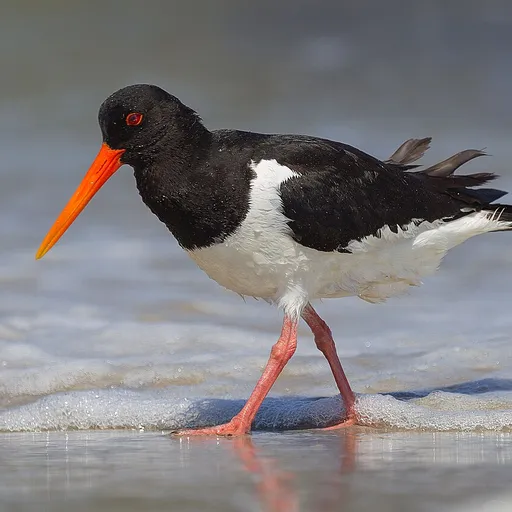
Eurasian Oystercatcher
Haematopus ostralegus
Near Threatened
Listen
XC707023 · Sonothèque ADVL · Carolles, Manche, Normandie, France · CC0 1.0
Overview
The Eurasian oystercatcher (Haematopus ostralegus), also known as the common pied oystercatcher, is a large wader in the family Haematopodidae and the most widespread of its kind. It is characterised by a long-lived lifespan and a monogamous breeding system with pair-bonds that often last for many years.
Identification
- Plumage: Striking black and white with an obvious and noisy plover-like appearance; white patches are visible on the wings and tail in flight.
- Bill: A long, straight, and strong orange-red bill, with the female’s bill being noticeably longer than the male’s.
- Features: Red eyes and relatively short, dull pink legs; young birds appear browner with a white neck collar and a duller bill.
- Voice: Produces a distinctive loud piping call.
Habitat
Commonly found in lowland plains that are flat, have short vegetation, and are close to water, as well as on pebbly coastal or inland gravelly areas. It is a migratory species that breeds in western Europe, central Eurosiberia, Kamchatka, China, and the western coast of Korea, with winter movements to North Africa and southern Europe.
Diet
Eats molluscs such as mussels and earthworms, using its strong bill to pry open shells or hammer through them. Individual birds specialise in either prising open molluscs or digging for worms, a technique they learn from their parents.
Did you know?
An adult ringed in England in 1982 was recaptured in 2025, making it at least 46 years old. It is also an important indicator species for ecosystem health, as it is the only wading bird capable of opening oysters despite them not forming a large part of its diet.
Sources
- Wikipedia · CC BY-SA 4.0
- Wikidata · CC0 1.0